Tuesday, September 11, 2018

Roby Canyon Hackamore: Progress

Progress has finally been made on the Roby Canyon set:  all that's left to do are the hobbles!  This piece is definitely for larger models.  I photo'd it on my Jezail (Shagya/Kaalee) this morning, and it fits her even better than Dry the Sea/Ichabad Crane.  The grey mecate came out beautifully, and it's all of 31 inches long!
This is the longest mecate I've ever made.  Even though it's a perfect one-ninth of a full-scale 24-foot mecate, it still seems incredibly long.  It's almost too long for this horse, and he's big!

Over the weekend I managed to finish Bosal 2 for this set (below right).  Somehow, it, as well as the mecate, came out a scoosh too big.  I tell you what, folks (voice of Bartok the Bat here), proportion is the greatest challenge in model tackmaking.
I failed to double the foundation in the heel knot (the white).  Tired of fuss, I chose to let it be.  The earlier, smaller bosal now has grand ideas of its own hackamore, since the earlier mecate did not sell.  (Read:  didn't fetch what I wanted it to.)  If dreams can be counted on, such a hack might have silver... never mind I currently have 4 other small pieces going...

Meanwhile back to the vision I saw in that canyon in June!  Finally putting the pieces together and finally getting a morning without rain, I had a little photo shoot... and the trees promptly dripped water on him.
This is not the easiest piece to take on and off.  You need to untie both the fiador and the cheek strap.  I've long accepted models' inflexible long ears.  This horse has such a sweet face.  :)

To suggest what the entire rig might look like, I added the closest thing I had to a plain TSII saddle.  This is TSII #117, from 1985, my first good basketweave.  It's 33 years old... still looks good to me...
Remember I'm selling the Hackamore, NOT the saddle!!
The mecate's tail end, or leadrope, is tied to the horn.  The mecate is looped in the bosal to take up the space between jaw and fiador.  I love this picture (below) because it caught the curve of her neck and the dish of her face.
Only now do I discover how easy it is to pick up the horse with one hand and get a close shot with the other, at an angle that shows the tack so much better than standing her.  How long have I been shooting ponies here??  Twenty-five years...??!?
The jaw strap is actually needed on such a large head.
I recently found out the Spanish term for the tassel at the end of a mecate:  la mota.  This tassel and its button are better shown in this shot:
I was going to end here, but this last shot seems perfect for the day.  It's 9-11 and this is a frightened horse.
Reach out to your loved ones today (and every day).


Saturday, September 1, 2018

Spinning Fate: Mecate Design

I've finished one mecate and am deep into the second - my first grey one, for the Roby Canyon set.  Both these mecates will eventually be up for grabs.  Yes, the one above is now available (customer wants another).  In the process of making the Roby, I seem to be spinning off so many spare parts that a second hackamore could almost be made!  However, given all the small pieces I'm intending to do right now, I think the best thing to do would be to sell those parts by themselves.  See the last paragraph for my current plans for these.

It was yesterday I decided to test my grey mecate design ideas by wrapping the strands around my Needle Awl and photographing them.  I'd never done this before.  Previously, mecate designing was all done on paper, in my head, or on the rope itself in the process of starting the spin.  There are only 5 colors!  But this way I could capture the subtleties and examine them at my leisure.  I was so intrigued by my results I decided to blog about them.  There were indeed subtleties -- and there was a clear winner.
This is what I had to work with.  You are looking at a week's work.  Each one of these strands takes 3 to 4 hours to make.  They're crafted entirely of hand-spun thread.  Although the photo doesn't show it well, the checkered strand (left) or 'check' as I will call it, is a pioneer.  It alternates white-black with white-grey.  I dyed the grey myself, as documented in a previous post.
The pair on the right, the black and white, are connected.   They will provide one black and one white strand, while the others provide two grey strands and two check strands.  One of the solid greys will be the core.

In the course of the Roby, I'd drawn a lot of design tests.  At first I took them from real mecates.  Later (the black ink ones) I invented my own.  I was pretty pleased with that last one (lower right) and decided to go with it...
...even drawing it up in my current N.A. Notebook.  "Dry" refers to Dry the Sea, the horse modelling for the Roby set; he is known as Ichabad to the rest of the world.
And then, as often happens, I was hit by a new and wonderful idea.  At least it happened before I'd actually started spinning!  Oh these inspirations.  They can be astonishingly worthy new ideas or they can be the most time-wasting rabbit-holes...!  My standard method of making Trad-scale mecates indicates only 5 parts to the twist (the 6th makes the core or 'inside' of the rope).   Yet my research revealed I'd once made a 6-part, that is, six strands visible with a 7th inside as the core.  Of course that means a lot more colorful options, and I was taunted, not to say tormented, by possibilities!!

What happened next was 3 days of rest from the Roby and completion of the first mecate, which turned out to be incredibly difficult (as well as taking three times as long as it should have).  (I had cut it too short and was busy figuring out how to extend it and undo a button with a lot of work in it.)  I had had an exciting night pondering the grey's design (amoung other things), and I thought it didn't have enough black in it.  My morning-after answer was plain:  check-check-white-gray-black.  To quote:
"Altho this doesn't place white next to black, remember the check strands are unusually white.  The grander, larger overall pattern is a simple alternate.  Altho I'm not completely "in love" with this approach for TSII mecates, I feel a 6 is way too ambitious at this time.  We are SO behind!  Also this 5 creates a way to show butt-joins for ABFTMH [pronounced Abaft-muh] which is really important!!"
ABFTMH, dear readers, is my next book:  Advanced Braidwork for the Model Horse.  (hint:  probably years to go yet...)
Butt-joins, for the uninitiated, is my phrase for where two threads must be stuck together end to end, with as little overlap as possible. 

It was a bit tricky to get the threads to behave for these shots, but a weight laid on them on the left helped.  I'm calling this first design One.  It is my original idea:  check-check-white-grey-black.
Here's Two.  The gray has been placed between the checks.
Another photo of Two, aligned the same as One.  white-black-check-grey-check.
I started to be unhappy about how the greys all disappeared into one another and how the white didn't contrast well.
Here's Three, checks next to the black.
Here's Four, black between the checks.  It didn't work quite as well, I felt, because the checks 'bled' into the black and the white was undistinguished.  By which I mean not having much contrast.
And here's Five, with the white between the checks.
At this point I suddenly realized One and Three were the same --!!  one read down instead of up.  Duh!!!  I also realized I wanted the checks to be together.  They were so pale, evanescent; they needed multiplying for strength.  That was the problem with Five; a single check wasn't very effective.  (It would've been more so if it'd been solely black and white.)  I could either have black and white together in my mecate or checks together, but not both; if I did, I'd have Two or similar.  The problem with Two was the greys didn't show well.  I did want the gradation white-grey-black.

And so my problem was solved.  My first design, the one that came to me in the night, had after all been the right one.  The rabbit-hole had been just that, a detour unnecessary.  Why did I have to follow all these detours??!!  My self-discipline is very ragged around the edges!  But at least I had some good ideas for next time.

Ever since then I've been spinning like mad.  It takes just as long to twist up the finished rope of a mecate as it does to make the strands -- more so, when I try to smoothe it out and all the inconsistencies bunch together and ruin things.  I can only go a few inches at a time; ideally, I now think, one inch at a time.  This is rope-making in miniature, and all parts must be even tensioned.  And that's hard, really hard.  Somehow mecates are the second-hardest piece of braided tack I can make (behind bosals).


UPDATE.  As of Sept 1 the grey mecate is finished; look for pictures on FaceBook.  Also, I have finally decided to take offers on the brown/black/white mecate (illustrated here and at top of post).  HORSE AND OTHER TACK NOT INCLUDED.  I'll put the small Roby bosal up on eBay; this auction will have to wait until after the 10th because we plan to be out of town.  But the mecate is indeed up for grabs.  You could email me right now.  : )  Given how much time went into it, I am hoping it could fetch around two hundred; but we shall see.  I'll put it up on MH$P and we'll go from there.  A deadline for mecate offers would be Sept 10th, at 9pm EST.
Thanks for looking!

Tuesday, August 21, 2018

Opening Hillingar

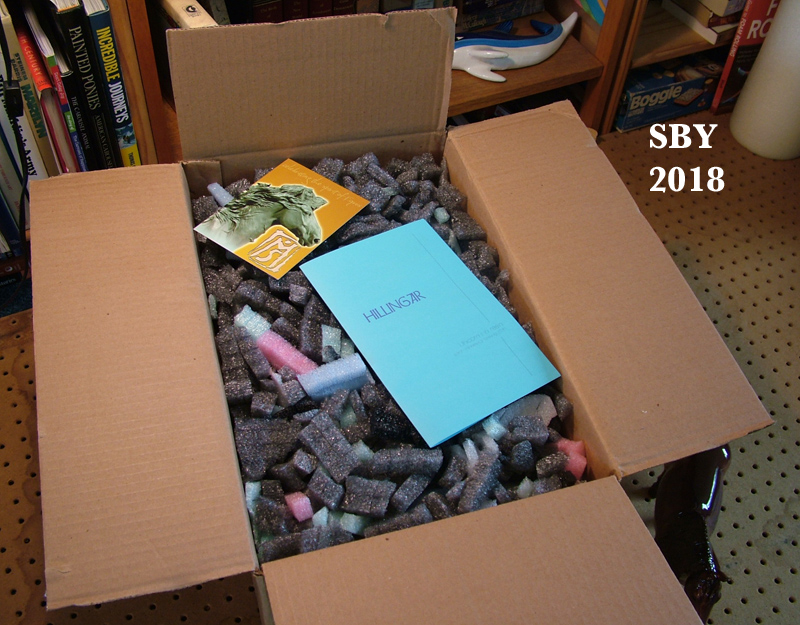
I unboxed my Hillingar today.
In the battle between "I daren't show the world how lucky I am all over again," and "I'd love to share and show off this beastie," the sharing seems to be winning.
I'd wanted him since first I saw him, back in 2015.  It seemed a dream.  When my name was drawn I could hardly believe it.  "So this is what winning the Lottery feels like."  I'd set aside the funds for at least 2 years - more than necessary it turned out.  When the box arrived I was amazed at the size of it.  Toucano (Straight Bet) is here to provide scale, as well as participate in genuine adventure.  He is one of my newest horses but is here to provide a steadying influence.
Trust Sarah to use a packing material I've never met.  It appears to be cut-up chunks of foam.
This is what the paperwork looks like.  Sarah explains her VARA rights.  As if I'd have the courage to paint him.  Even carrying him makes me hold my breath.
First glimpse.  Honestly, up to this point I had had a very fuzzy idea of how big he was.
There appears to be a large stiff piece of cardboard fastened to his side.  How interesting.  Picking it up I realize she's using it as a brace and protector.
He sticks out in all directions.  This view of the back of the cardboard shows his tail!
Denouement.
This is one clever design.  I had wondered.  Would the horn be separate?  Nope.
That's the tail.
Toucano/Straight Bet helps show the size.  Hillingar is a bit larger than I expected.  He's so full of intensity he seems to vibrate.
What an amazing creature.  The word that comes to me is fey.  Mind you, I just got through reading Karen Moning's FaeFever series... !!
I am so astonished.  What I'm amazed at is not his sculpture,... her gifts are obvious... but that Sarah had the gumption to somehow find a way to cast, pack and ship this dream.   How many dreams are intense enough to last for 3+ years after completion?
I am absolutely not ready yet to paint him, consider selling, or even name him. 
Thank you, Sarah.


Sunday, August 19, 2018

Mecate Confessions

Though this photo doesn't show it, this mecate is at the end of its rope (o bad pun).  There is little more to do than tie the tassel knot and button on it.  It may not seem like much for 2 weeks' work, but it's been a hard row to hoe in several ways.
To begin with, I confess I had to re-learn how to make my own mecates.  I spent the first of the 2 weeks spinning up its three strands the wrong way!!  I use two ways to spin, or twist, thread together:  in combination or in opposition.  The difference depends on whether I want to combine smaller threads or set them in contrast.  Somehow, despite my own notes and pages of drawings, I settled on combination.  (stick out tongue and make a face)  I'm not sure why.  The last hackamore I did used combinations, but that was a year ago!  So after I'd done all three strands -- many hours -- I slowly decided I'd done them wrong.  The little nagging voice finally got to me...  I'd perfected the combinations, but...
Can you see how the checkered strand (the black & white) is irregular?
Combining the one-colored strands worked (!), but doing the black & white check (or fleck) that way was a sign I was on the wrong trail.
It should have looked much sharper and crisper.  It should have looked like this (below).  I eventually made the difficult decision to undo the entire strand and re-use the threads.  (Remarkably, the material stood up to this extreme treatment.)  Here is the proper check strand with its earlier buddies.  Can you see how the slant of the check strand is in the opposite direction from the brown's and the white's slant?
It's a cardinal rule:  Mecate parts must lie in the same direction.

After I fixed the checkered strand, I also un-spun and re-spun the brown and the white.  And that took more days.  It's a good thing these discoveries and decisions come in waves.  I'd never stand the shock of being proven so wrong all at once.  The customer is patient, for which I am so very grateful.

And that's the next confession.  This mecate is not for the Roby Canyon Hackamore at all.   While at NAN I let an old performance shower talk me into a short order.  The current state of affairs at the TSII is designed to let the artist choose what they want to do...  I needed the personal impetus of a direct order...  I was going to be making mecates anyway, for the Roby...  and, oh yeah, I happened to need the cash.
The deeper reason seems to be that when I'm stuck on a piece (I was stuck on the Roby, over whether to make a larger bosal), I go for something else I think I can finish fast.  Except this time the something else got stuck too.
Rats.

I can think of two connected silver linings to all this cloud of trouble.  The first is that this mecate refreshes me for the Roby's.  Yet another time through my recipe gives me yet another chance to perfect and standardize them.  Since I learned how to spin thread (over Christmas 2000, thank you Judith again) and used it for mecates, this will be my 23rd mecate.  At least with saddles and braided bridles, 24 seems to be my magic number.  Twenty-four iterations before every last possible bug and kink is out...
The second silver lining is further refinement to my notes and drawings.  Below is a sneak peak of something destined for my next book, a rough draft of a plate for mecates.

Here's a closer look at the current mecate under construction. 
 I had forgotten, also, how very hard these mecates were to make, once the strands were done and I was on to the second wave of spinning.  A half-inch at a time is reasonable.

Earlier posts on mecates include December 8, 2012 , Three Mecate Artists, and Fancy's Hackamore 2 mecate (2 parts, of which this link is the first).
Enjoy!

Tuesday, August 7, 2018

Starting the Roby Canyon Hackamore

It is difficult to create in miniature something you have neither photo nor drawing for.  I am proceeding from the memory of a single encounter with a young Appaloosa mare and her rider, and their hackamore (which I fell in love with on the spot).  The encounter happened late on a June day in the Black Hills of South Dakota; it was on the road through Roby Canyon, which is in the western edge of the Hills.  Although the meeting was short, I felt it was important, and almost immediately afterwards I wrote down some details on the back of the bird list (the usual place for such things).  This lean paragraph is my best evidence for what I'm now trying to build.

"Bosal 1/2", Natural w/ dk brn nose, banded heel.  Slit-braid hangar [sic], no deco.  Fiador light-colored w/ dark fleck, tied w/ wooden beads!!  Mecate black, white & gray.  Matching hobbles w/ 2 braided connector hangars [sic], w/ banded buttons!"

[Having an ex-pilot in the family, I do tend to spell "hanger" the airplane way.  :)   It's hard enough to learn that the equine term for the headstall for a bosal is not headstall but hanger.  : (  The same ex-pilot is also a military buff, leaving me trying to remember that a sword's supporting belt and strap is also called a hanger.]

The bosal was obviously the place to start.  And here is where fate stepped in, in the shape of Ichabad Crane!!!  Alas, alack, for 20+ years my measurements and formulas have been for a true 1:9 model horse, and my bosal recipe is perfected for:  the Stone ISH.  When I started the bosal for the Roby Canyon Hackamore I was more concerned with the fact I was going to be putting interweaves in the nosebutton when my memory clearly told me there were none (this is the TSII!!  showing off fancy braidwork matters), than worried about whether to allow for the turns of the mecate AND the fiador.  Of course it would fit.
I got the sidebuttons properly located relative to the eyes.
 The pin shank in the middle is holding space for the future heel knot concho's pin.
Finished.
My adventures falling in love with Ichabad/True North, named Dry The Sea (chronicled in the previous post) were beside the point.  It was only natural to set him on the tack bench, right?  Natural to somehow switch my attention from an unchosen Trad to this intoxicating bay, so popular, so long desired.  I'd shaped the bosal to him, hadn't I?
Natural to make the fiador for him, with more attention and size than I'd ever made a fiador before.  It was braided from 6 threads instead of spun from the normal 4.
Below is the fiador tied in a traditional hackamore knot.
 This picture (below) shows the mass of thread the wooden bead had to encompass (the 4 strands below the jaw, right near the tip of the out-of-focus strap).  It also shows one of the files I used to make the bead with.  It turned out beastly hard to get all that mass through the bead.  At model scales, Roby's two beads became one.
I made the wooden bead from a bamboo skewer from a Chinese restaurant, by the way -- bamboo polishes up in scale better than most woods.
I did research to find how the jaw strap attached - and then chucked it and just cut a larger strap to hold a slit.  The full scale Roby hackamore had used a jaw strap, to keep the cheekstraps away from the eyes.
And there you have it:  I'd switched horses in midstream and hadn't realized it.
True North, aka Ichabad Crane, aka Dry The Sea, was truly a much bigger horse.
There wasn't going to be enough room for the mecate.
I should have known.

On a different subject,
Why did this encounter, unusual but not rare, inspire me so?  I've seen other riders while we were out birdwatching.  I've got the whole world of Internet images to draw upon.  I've got years of experience as to what training hackamores look like (which was of great use when it came to buckling down to this piece).  Perhaps it was the wooden beads, obviously an easy way out of tying those bothersome fiador knots -- they looked so cute.  Perhaps it was the color of the mecate; I'd never before made one with gray.  Perhaps it was the stunning beauty of the hobbles combined with the headgear -- I'd never before seen braided connectors used to hang hobbles with, let alone matching colored ones.  (In the paragraph, 'banded' means "having contrasting braided interweave rings.")  Duh.

Perhaps it was the beauty of the horse.  She was a stunner, a blue roan with a patchy snowflake hip blanket and plenty of spots.  Spirited, barely under control, young (of course), great conformation.  Perhaps it was the friendliness of the rider; she let me approach and pet and gawk.  There was a second rider, on a pale palomino, but these two merely threw the App into relief.  Geo and I had been noting the tracks of two shod horses on the dirt road and knew they were ahead of us, but only chance had caused them to turn around before we did.  The moment I saw them I transitioned from the birder's best public-relations (you have to evolve this if you birdwatch long enough) to the heart of the tackmaker, well knowing what I was seeing.  "Rosie" the mare rolled her eyes at me.  The rider, however, complimented my hat three times.  : )
Image from California Classics via Google

Why would a supposedly-Trad-scale model horse be so large?  One might as well ask why one's artistic work expands when one's spirit does.  This isn't the place for such weighty questions.  I'll settle for measuring Dry The Sea.  He appears to be 6  5/8" at the withers, which translates to <oh, this is shocking!  My math works out at very close to 1:9:  1:9.05 !!>
<Try it yourself:  Divide 6.625 into 60, the inches of a fifteen-hand horse>

I'm supposed to be deciding whether to make another bosal, bigger this time, for the horse I've so clearly let sweep me away.  Spluttering -- there's water in my seas yet -- I can only say this will take more time.  I want to be working on mecates right now, and I've started.  I'm pleased to say I dyed some thread last night, and this is what it looked like:
Just that amount of thread perfectly used up the dropperful of rubbing alcohol I'd started with.  No leftovers.  I like the imperfect effect of home-dyeing; I think it much more natural, more true to real horsehair, in this case gray horsehair.
Stay tuned while I spin.  Mecates usually take a week, but we'll just see what happens.