Saturday, April 9, 2022

Incosante in Tack


 I received my Incosante from Sarah Minkeiwicz yesterday and opened him today.  I had not expected the stickers!  Almost instantly I was prepping him -- without thinking, an unknown time went by whilst I happily scraped and filed, sitting at the tack bench and admiring all the details close-up.  He is perfect.  There is not one error.  This is a horse I have wanted since he was sculpted before our eyes, because I knew he would be perfect for Spanish and Mexican tack.  What I also hadn't expected was quite how excited I was to try him out with pieces long hidden.

Here we are getting white dust all over the pants.  How can I say this is not scolding his amount of flashing, but rather totally enjoying the chance to make him even more mine?  The casting was very very good.


At first I put him into the bridle for TSII #413, the piece I am currently working on.  It's braidwork, it's what I had in mind.  Fair enough.  His head is compelling.  It's an advantage for a tackmaker's horse to remain unfinished.
The character!!  His working his jaws so clearly tells the story of what he thinks of that bit!  Unbelievably, Sarah had even given him gums (along with the teeth and tongue).
I was so eager I hadn't even put him on his base yet.

Following my heart, I pulled out the Emma Harrison braided-bridle collection I had so painfully acquired back in 2016 or so.  Emma is no longer with us.  I felt that the detail and character of this horse was, finally, absolutely perfect for the calibre of tack I had gotten from Emma.

These are museum pieces.  These are some of the most exquisite, unbelievable examples of the miniature braiders' art I have ever come across; they're the best I own.  They cannot be worn but by exceptional horses. 

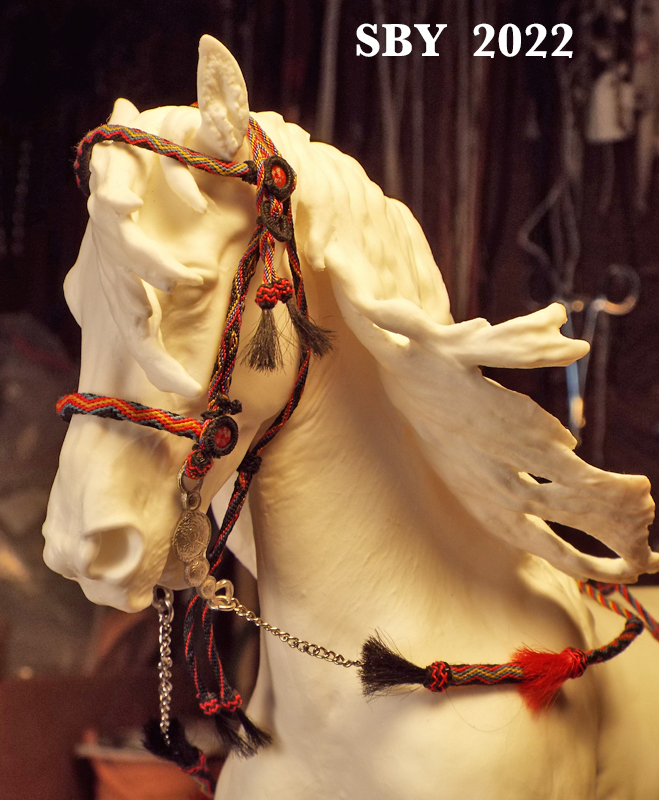
Some of these I have never photographed on any horse before.  The Red Hackamore is like pure gold.  When the photo below was snapped I was astounded at his classic beauty.  No processing of the shot was needed, except for resizing.

I'm overlooking that Inco's forehead is really too large for these pieces (browband too short), and that the cheek pieces are a bit too long.  Doesn't it seem like he's trying to grab that tassel -- ??

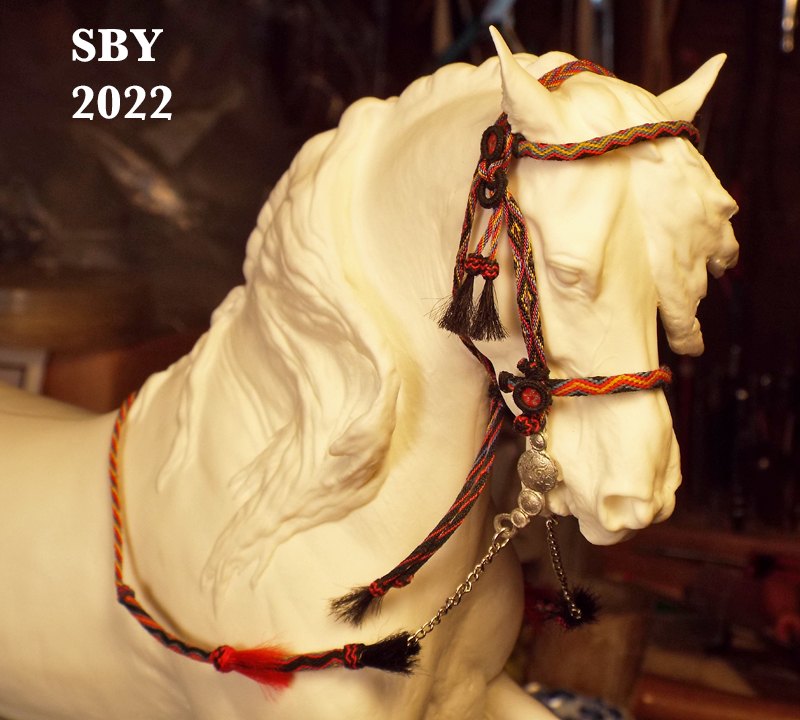
This next bridle is the most incredible Harrison piece in my collection.  It's the most astounding miniature hitched-horsehair bridle I've ever seen.  Inco's on his base now -- I've managed to catch my breath.

I last photo'd this piece on a carousel horse; before that, never.

Such classic proportions!  His mane is full of fenestrations, as you would expect for one flying in the wind.

All right, she forgot a curb strap.  But look at that detail.  This tack is not painted, but actually woven from rayon and polyester thread.

I adjusted the too-long cheeks by looping them up over the browband conchos.  Yes, the whole thing is adjustable. 

I honestly feel that the incredible detail of the horse is equaled by such pieces as these.  He inspires me.  My tack collection, or tack museum, has been too quiet and tucked away for too long.

Incosante, whom I'm temporarily calling Inconstante (inconstant), might also be named Encanto, for enchanting.  Surely this horse was sent to remind me of my capabilities with my favorite type of tack, braidwork, Spanish, Californian and Mexican.  Thank you Sarah; no words can find praise enough for your eye for detail and exquisite capture of the very soul of this animal.

This might be the start of a lovely relationship.


Sunday, April 3, 2022

Paddling Lake Guana


I started out writing about pizza, injured thumbnails and pandemic exit stories.  In the process, transcribing our two latest trips, one in December and one in March, took over.  After yet more changes of direction, I finally wound up here, at Lake Guana, part of Guana State Park on the northeast Florida coast, south of Jax.  This is a lovely if challenging place to canoe, one which we've previously visited twice -- the last time in 2014.  We paddled here during this year's Spring Break, March 3rd - 13th.  The day just happened to be one I fully wrote up in my Notebook.  Parts were heavenly fun.  I decided to pull it out and give it its own post, aided and abetted with photos taken back in 2014.  Ahoy, Mateys, all aboard!!

[Written 2203.10, Kingsland GA:]

"3:30 am.  Gnat/chigger/mosq bites under my chin, at crook of left knee, left wrist, sides of neck.  Sunburn both sides of neck, lower lip.  [...]  Sore elbow / Tendonitis on rt returns at night, its original attack time:  why would it not hurt while canoeing harder than ever I have this whole trip, but shows up in the wee hours & in the morning??  It must be a cooling-off / cold thing... [...]

Shore of Guana Dam, Wood Stork on beach

"While truly we are having the time of our lives, the best, most triumphant trip so far.  A giant step towards the After Covid.  It may not be really so -- no data, no numbers are we seeing;  no eating in restaurants, no theatres, no shopping, no entering crowds of any sort -- but it FEELS so much more like the Before Times, that it's a shock every time I see a mask on somebody.... 

"Yesterday, the 9th, was GUANA RIVER day.  A big success, if you don't count the sunburn and insect bites!  :)  We had 9:45 to 12:45 three hours of classic Guana Lakeshore, lower water & higher wind, but still much sun.  The 1st hour was the best w/ me in the stern and "sack o rice" Harrison-Ford-like cruizin' in the front.  We hugged the west shore so's to be out of the wind.  Great swathes of sun rippled down along across the forest over us like water reflections.  Surely that is one of my favorite shore paddles....  

"Distinctive w/ its windcurved profile, thick oaks and bays & Spanish moss (?lichen?) interspersed with sabal & palmetto and GIANT pines.  That King pine!!   Even dead they are the most strikingly beautiful tree.  I am a horrible photographer, I let that Osprey get away.  But I took stills & movies and 2 of Geo relaxing w/ bare feet, an iconic shot if ever there was one.  We floated downwind like Opus on his barge.       


"The second hour was beating back upwind, still along the shore & thus very shallow, making up all the distance back.  Geo paddled.  We saw a group of kayakers launch from the sand beach, & come towards us.  |  At the corner Geo had us go along the dam end just enough for him to look back & read the sky.        All along, the day was to've been a race against a storm.  But that morning gave us a bonus.  What he saw convinced him we had more time than we thought.  The sky to the West was still blue between clouds all the way to the horizon.       

"He surprised me by proposing a dash down the center of the lake.  The wind and I mean a strong breeze, sailworthy wind  was on our port quarter.  That was a hard dash.  I strained and struggled to keep her true.  The pressure seemed to veer her either left or right.  He was trying to teach me the value of a bowman in keeping trim.  I had him pulling (pointing) her right & it still wasn't enough.       What I learned was I could barely keep up by ruddering & wide-stroking on starbd & was quickly exhausted.  !!   I had to wide on port.  Even that was tough.  We got down to mid-lake, past our 1st hr turnaround, in 15 minutes!  He angled in toward shore & we turned & began beating back,  not in the sailing sense of tacking, but in a canoeing sense of slow continuous shallow-sweep paddling against a headwind,  right through eight kayakers in 4 huge double kayaks.

"Nothing is funnier that hearing somebody else yell "No! No!" when you know they are landlubbers experiencing a stiff wind; and you are professionally & experienced-fully safely in control, going up the least-windiest shore.  Most sheltered, most in control, we watched them plow past us all the way to the marl point, midway on the western shore. [...]  

"At the end of the 3rd hr & the second keen glance to the western sky, Geo made the decision to quit.  The sky was still largely blue-&-white but the W horizon was one vast smear of white.  It had tight cumulus heads embedded in it.  While we were taking out, on the beach, a cloud tower over our heads obscured the sun.  We had a leisurely, careful haul-out in unusual conditions because of the very shallow, very hard sand/shell/marl bottom.  Barefoot wade!!  This was one of the very few times we got to wade her in:  Take off shoes & sox, roll up pants, step over the side & lead her to the beach.  |   Geo got out first (he grounded first, hah!) & I got to ride.  Of course I grounded in a couple of lengths.  So then I knelt forward & rode on my hands & knees, straddling the thwart, so as to center my weight.  Got a few more lengths.  Geo drew her 3/4 out & I sat there in the stern & re-shod myself.  When I was finally out, he merely went back in, sat on the stern, rinsed his feet & reshod too.  And stepped out.  It was, he said later, our most elegant take out yet.


"Driving back North via palmetto parkway & 1 & 9B, we experienced the most awful storm.  Somehow we were not blown over.  Moxie rocked!!  It was torrential.  We wound up in John Muir boardwalk outside Yulee.  A nap & read before Whataburger was much appreciated."

So you see, drive-throughs had become standard by this time.

Laughing Gull on depth post at Guana dam

One more nugget on Lake Guana:  a movie taken in December 2014.  It is about 41 seconds long and reveals the entire western shore line as the canoe gradually swings to the right.  You can hear us talking.  It's a good glimpse of the forest and the water's edge, as well as a sense of the timing of our canoe rides.

Where have I been for 4 weeks?  One went to Spring Break  :),  at least one went to taxes.  The others, well, I have been deeply conflicted about pandemic and I suspect the accumulated stress all just became too much.  I am still struggling with how to do BreyerFest.  Is my imagination good enough to envision (and manage!) outdoor and/or safe visits with those I wish to see?  Can I invent my BreyerFest without indoor jamming, without crowds, yet with those elements I love?  I can risk my own life but not his.  Like I said:  it all became too much.  As ever, we'll just have to wait and see.  The numbers might keep going down.  Hope is painful.  But Spring is coming.


Wednesday, March 2, 2022

20M: Bells and Housings


Finished at last!!  This post will cover the final 3 parts:  bells, housings, reins.  From the beginning the question was how I would do those bells.  They were created nearly last, which tells you how hard they were.  I conferred with other tackmakers;  I looked online, I pondered and struggled and conducted thought experiments.  I had people advise me to try 3D printing.  I looked in dollhouse supplies -- did you know you can get miniature handbells?!  I thought about making metal ones.  I considered leather and plastic and Fimo.  Like miniature carousels and model trains, the bells wouldn't -- couldn't! -- ring;  any musical effects must be done with a recording.  In early January I started carving bamboo.

I had used bamboo before, to make a hackamore fiador button.  Starting the Roby Canyon Hackamore.  Narrowing down on wood as the right material, I remembered the glossy smoothness and ease of working with it.  You gotta say this for it, bamboo's easy to acquire.  Just one of those cheap restaurant chopsticks has supplied all my Twenty Mule Team bells.  By the end of January I had a procedure.

The drill bit is for the central hole.  The paper is an index card.  I needed the cardstock for the rims, as the bamboo was not wide enough.  It's possible my earlier experience with my  Woven Wicker Chair exposed me to the dollhouse miniatures practice of building just about anything from cardstock.  White glue and filing and drilling did the trick, but it took a LOT of filing.

Of the first two bells I made, one was much too large.  Again and again the lesson was driven home about how SMALL these mules and their gear really are!  It was punishing to hold these itty bitty slippery shapes in hand while I filed them down to the correct shape.

Next, paint with PearlEx.


There were many stages of fill and file, to blend the line between rim and bell.  I was using white glue as filler.  A typical bell would take three cycles of fill, dry, file and paint.  Hollowing out the throats took knife-work as well.  I was a bit worried the rims would fall off, but the paint helped.

Making the bell frames started out easily enough, went through a very hard stage and then revealed a miracle.   I knew they'd be of aluminum strip.  I shaped them by eye.  Plated pins became my clappers, holding the bells to the frame with a surprisingly nice amount of dangle (it was impossible to affix them firmly).  I ranged the largest bell in the middle and the smallest on the outside edges, just like real life.

But how to fit the frame tips to the hames?  This was a place that proved to be very difficult and went to the heart of model tackmaking:  it was a pure engineering challenge.

The full scale reference showed little black metal pockets on the outside of the hame tops.
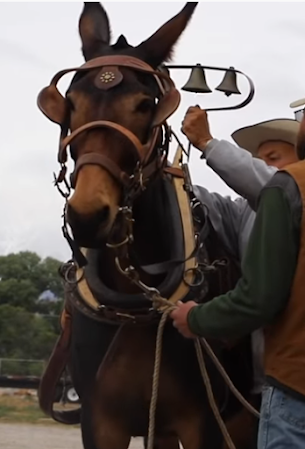
YouTube ref v=nPq3m7ueP8Q
But I had a different collar and hames to work with.


Not only was there delicate silvertape and notches on the outside of my hames (no room for pockets)(no strength either!).  Any adjustment of their angles (bringing hame tips closer together) would have meant a complete re-doing of the hame straps, their buckles and keepers.  I had put so much effort into those straps I just couldn't face that.  I test-fitted my bell frames, and it was plain that their ends would fall inside and not outside the hames.

This was the solution.  Here I had room for pockets.  This would work, barely.  The earlier-mentioned miracle was figuring how to roll the aluminum ends into spikes, making the frames stronger, much more realistic and able to fit in any pocket.

This curling was done with pliers, amid much squeezing.

So much nicer!!

I tested my pocket idea with drafting vellum, which is a kind of tracing paper.  Impatiently, I made another pocket out of very thin aluminum.  Drilling and filing slits into the hame tops was nerve-wracking, not least because I had to take the hames off the collars AGAIN. 

But it worked.
The pocket itself looked like this, before clinching:

When I painted them black, I was shocked to discover the vellum one (left) looked just as good as the other.  In a snit of pride, I decided to keep both.
Of many hard parts to the Twenty, this was one of the hardest.  It became even harder when I changed my mind about the black paint, and scraped off nearly all of it.  I should have done that while the hames were off,...   Take a look.  Don't the black stubs sort of stick out visually?
 It just struck me as distracting.  The real ones were not like this.

And now look at them.


But this is getting ahead of myself.  Were the harnesses done?  Oh my goodness no:  There were housings and reins still to go!  Bearing down...

Fairly early on I had designed in my head how I was going to do the housings, or collar top covers.  Every mule had them though only the Leaders' and Wheelers' housings were spotted.  Tiny silver spots are 'house special' for the TSII.  The letters, for Death Valley Conservancy, were too small to be done with individual spots and would have to be conglomerates (a fine pun).  This photo shows nearly everything about how I made them:  the ikandis from which the spots and letters were cut, the paper pattern for the housing, the tiny stamp for the circle (source: Dad;  braidwork: Sue) and the knife which helped cut them out.  I also used a Needle Chisel, cutting very teeny triangles, getting a 'ripple edge' on the letters.


Shaping the housings was done largely by hand.  The scale was such that what were undoubtedly slits in full size became holes and slots in 1:18, to allow for the bulk of terrets and rings.  Heavy oiling and working gave them close to the limberness and flexibility I was after.  A great challenge was whether they would lie close enough to the animals; but, amazingly, they sat pretty much in place.

Their purpose, by the way, is to protect the vulnerable place on the animal from sun, rain and dust.  


Spacing the letters correctly caused me one of the last and largest, but mercifully shortest, headaches of the whole set.  Let's just say there was an extra housing made, but I benefited from the practice.

You can tell which pocket is the vellum one; I couldn't get the black off (above, right).

Almost unmentionable so far, (because the last steps are always the hardest), is the making of the reins, lines and various cross-connecting straps.  Each mule has a leather check-rein of closed reins.  Each pair of mules has a connecting strap between them, going from a hame ring on one side to a halter ring on the other.  And the Near Lead, because he bore the jerk line, had no checkrein on the near side, but a short buckled strap on the off, from bit to hame ring.

Oh yes and there is the famous jerk line.  Long strings of teams like this were driven with a single line:  a steady pull indicated 'left,' a series of jerks, 'right,' hence the term.  I chose to make this set's jerk line about 4 mules long, from a white string I'd had hanging around, possibly from kites.  For 7 months I've been telling myself this Pair is all I'm making; so it was a secret unknown stab into the future when I found a ten-mule-long length of line, perfectly in scale, matching this shorter line, and set it aside.  Any old string will not do; it has to have the right twist, an appearance of turns and texture for the scale.
A tiny hook-and-loop of wire to carry the jerk line, and the 20M Lead Pair was done.

Hard to believe!

More than 34 weeks went into these.  If I'd been doing nothing else, it should have been a couple of months.  All other mules of the Twenty have no bells,  and most have no spotting on their housings.  Behind my own back, I screen-captured references of the Wheelers.  That would be a challenge; there's a saddle on the Near Wheeler of a type I'm not familiar with.  I make no promises.  I only sort around in the back of my mind which parts could be mass-produced:  the rivets, the buckles, the hames and collars and reins.  Semi-mass production is a familiar concept;  OrthoFlex Saddles first introduced it to my awareness.  We'll just have to see how attractive such a standing order would be when ranged against future braidwork projects, and other tack projects of unknown scope.

I'm looking forward to them.