Wednesday, October 22, 2014

Beginning TSII #454: The Gold Tipped

 Designing silver parade saddles has just about got to be my favorite model tackmaking job.  Using the i-kandis, which were so successful in TSII #447, Eleanor's Hexagon, makes it even more fun.  Here we are starting TSII #454, the next in line, with little to go on but the customer's wish for "full silvered" and my own wish for "a little touch of gold."  You see, I haven't yet gotten permission to do that, but already I'm off and running.

This is TSII  #447.  It was a trailbreaker in its day.  I've always wanted to use this technology again and intended to do so with all the parade saddles winning the 2009 Lottery.  Now that we are finally able to start work on them, it was sheer luck and a special pleasure to be able to personally visit this great saddle, recently, in September.
 Thank you, Eleanor.
We start by looking at a real saddle:
 This page is from a Bruce Lovins silver parade saddle catalog, a nicely produced reproduction which can be purchased from the source.  This particular design is called the Deluxe Parader.  I was inspired by my new-found ability to make the "4 tiny squares in 1" concha, used in the Deluxe.  What caught my eye was the gradually expanding line up the center of the serape (drape).  There must have been some inner guiding star that said, Make it gold!  So we go to the time-tested method of drawing a picture.  Years ago I had a standard drawing of a parade saddle to help me, but my patterns have evolved beyond that, and now each saddle gets its own.
You would not believe how much work is in one of these sheets, even at this early stage.  This is its second incarnation...  and it's got many more to go!   But rest assured, those little doohickies are the very ones that will be used in construction, if and when the thing ever settles into a final form.  I stick them on a face-up piece of tape, so re-arranging is merely a matter of prying them up and sticking them back down.  This also explains the ragged edges around the serape, which are Scotch tape remains.  In the drawing, colored pencil is used. 

A custom-made wooden anvil, or stamping block, is used for the stamping of the i-kandis.  It has pins and screws in it to hold up under the pressures and form centers for the various stamps.   My block is much used and dates at least as far back as my Louise Cottam saddle, which used the little star and ivy leaf in the lower right corner.  I much enjoy making my own tools... it must be where my customizing bones are.
The 4 pins near the center are the most recent, just put in for the 4-square concha.

At this point in the design process, most of the rough work is done, but many questions remain.  What color will the corona be?  If any?  What about the bridle?  I am not happy with the tapadero... can we improve it?  And WHICH drop to use!!! -- there are three different ones illustrated!!
From left to right: Squares, Triangles and Diamond.  They could all work -- that's the sweeping rush of creation, which spews out alternatives at a far greater rate than they can be digested or implemented.  Time must pass and the customer must be consulted before I can choose which one.

I know I promised a post on stable blankets, and I intend to still -- but this saddle has taken center stage.  I chose to let it.  At the moment of posting, it named itself.

Saturday, October 11, 2014

TSII #453: Roseleaf Roper

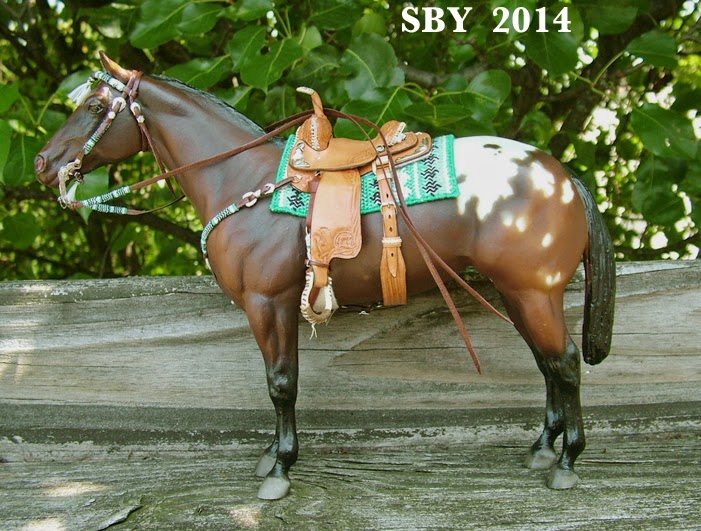
With much excitement and pride I present:  TSII #453, Feldman's Roper, nicknamed the Roseleaf!  Finished last night, this is the third saddle I've managed to complete in the year!  It does feel like I'm finally back in the saddle, -- dare I say.

This morning the lighting conditions were perfect for a few railing shots.  I was unable to resist tacking up Valhombra.  He is coming with me as Stowaway to Didi Hornberger's show this weekend (I leave today).  Every show has its stowaway.  A stowaway is a horse that isn't showing, isn't for sale, isn't exhibiting or doing anything useful, but who has to come anyway.  In this case it's because his wife will be showing.
This saddle was built on the ISH, but one naturally wants to try it out on other models.  As it happens I have seen my population of Carricks go from 1 to 3 in the past two weeks, so this mold is on my mind.  (The other two are Bonne Fete and Travis.)  It's a good test of a new piece anyway.
 One of the more obvious new tricks of #453 is the rawhide wrap around the horn.  As before stated, I chose to go with the simple approach.  This is ostrich rawhide. 
Another noteworthy aspect is the blanket.  I gave the customer the choice of existing blankets that I had made, or she could custom-order one.  She chose this one, a very special Reinata of Chris Armstrong design.  It is the one featured on this blog last year: Blanket Kit.

Valhombra makes a striking pose when taken from the front:  almost too striking!  That front foot tends to get exaggerated:
Still this is the best way to see the breastcollar.  Sorry, the hackamore has nothing to do with the saddle!  The colors matched and it was my own.... that's all.  Earlier, last night, we were shooting the saddle alone:
This is the best way to see that there is tooling under the cantle -- and it's not such a great view.  You'll have to take my word that there's rose leaves and the initials "TSII" under there.  Our saddles are all signed and numbered on the base plate (bottom skirt), UNDER the fenders, with number on the off side and SBY and the year on the near side.
If ever there was a color to fit the order, it's this horse!  Stone's Ima Hustlin Breeze from 2003, but in my herd she's called Rayonnant.I think the tackmaker, like a sculptress, sees the saddle most often and best from above.  This set's seat reflects that.
 
I tried so hard with this seat.  There's a three-layer sandwich of a tree in there, part metal, part leather.  It's not something I'd mass-produce; I admit, it needs work.  This piece truly is one-of-a-kind.  If, after you've spent months struggling with a saddle and finally finish it, the first thing you say is "I wanna do it again DIFFERENT in x--x--x--"  then you're a tackmaker!! 
As it happens, next is a parade set, so I'm one happy camper... for that and many other reasons!
 The braiding on the back cinch keeper is something I've only done three times before.  It's based on Grant's applique braid of 2 passes.
And now for something different.  I always like to see other folks' backyards and views, so here's a small entrant in the Scene class:  my own.
Rather green for October, eh?  but wonderful.  That's Bald Eagle Mountain in the distance. 
Coming soon:  a post on stable blankets!  Keep up with my news on our Tack Orders page, as always.
Happy tacking!


Friday, September 19, 2014

TSII #453 begun: Welts, Rawhide and Stirrups

This particular picture was taken last Friday, the 12th.  It's the beginning of TSII #453, Feldman's Working Roper, the third saddle under construction this year.  If fate is kind it'll be the third one finished this year!  When I think about the old days when I finished dozens of saddles in a year (1984 etc.)!! ... sigh...  but those had barely a fraction of today's detail.

TSII #453 was ordered to match a piece of headgear already made.  That piece was a Roper set, consisting of a bridle, tie down and breastcollar, created for the competitive English shower Karen Grieve, in 2005.  I made a lot of pieces for Karen.  I hated it when she left the hobby!


 Later that Roper set landed in the hands of my customer.  She entered my Lottery and asked for a matching Roper saddle.
I had made two Roping sets at this point (2005), one for Ann Bilon and the other for Karen.

Jump forward to 2014.  I don't know where most of July, August and Sept went, unless Blanket Fever (collecting Breyer blankets) is something of an excuse.  I'm hoping for a post on that subject sometime soon...
Just like TSII #452, the shoulders and horn of #453 got done first.  One of the big 'pioneering' efforts on this saddle was the braiding on the welt, the line (usually of stitching) that goes up the side of the shoulder of the pommel.  After decades (1979 to 2001) of hand-sewn welts, things changed with TSII #423 (Eleanor's Braided-Edge).  I invented an elaborate way of braiding the welt, which I used for 5 saddles and three years, up to 2004.  Here is TSII #423:
My other saddles that featured this fantastically challenging welt braiding are TSII #424, #425, #426 and #428.  It was a kind of flat braid.  And then came the Elk.
This saddle, built in 2004 (oh gosh it's ten years old!!) changed everything... again.  This time I tried using the welt's stitches as a ladder upon which to do the Three-Strand Applique Braid, which I'd just found out from Bruce Grant.  And to my amazement, it worked.  I've been using this trick ever since.  

Until now.
Why do artists stray from the path?  What makes them unpredictably seek out the unusual, the variations, the spark of difference?  The ability to err slightly, says Lewis Carroll, is what saved our DNA from extinction.  All I know is I did one shoulder with a lengthened Applique and then had no idea how to do it again.
I really struggled.  "Is anyone going to notice if the 2 halves are different?" refers to the thought of doing the usual thing on the other shoulder!  But in the end (it took overnight and 2 tries) I was able to catch and document what I'd done.  And the two halves did match.
Next:  a rawhide-wrapped horn.

I'll be honest.  I don't like Wade trees or saddles.  I think the thick neck looks ugly.  I was greatly relieved, after online research, to discover that not all Roping saddles had to have Wade-type thick necks.  A mere wrap of rawhide around the neck was enough.  But how to do it in miniature... I'd never done this before.
This is my second try:
Yes, that's real rawhide, even though it looks like plastic wrap.  Deep research (thank you Carrie) brought out that often a strip of mulehide was laid up across the front of the gullet; but dang it, I didn't want to cover up any of that beautiful braiding.  Call it pride.

The same thing was giong on with the stirrups.
Despite clear reference showing the overwhelming majority of Roping saddles having rawhide-covered stirrups with ONE row of (very plain!) stitching down their sides, that was NOT what I was building!  In defense I might point to the drawing I had submitted to my customer and she had approved and passed:
which clearly showed a stirrup with two braided edges.  But the truth is I am stuck on my own habits of fancy braiding and will use almost any excuse to do it on as many parts as possible.  Never mind reality; the artist wins on this one.  It's a Working saddle and as such should have plain parts.  I restrained myself on the tooling and on the silver.  But I decided to use real rawhide wherever I could.  Thus it was that the stirrup tread wrap wound up using some of my best rawhide... and covered the braiding as well.  Ah well.  Compromise, in a twisty sort of way. 
I did learn not to waste my rawhide on the stirrup neck wrap, because you absolutely can't see it.
We have progressed to the fenders.  I keep being reminded that even though it's not harness, there's an awful lot of strapwork on a Western saddle.  The fenders are a prime example.  Two buckles (one a tongue), two keepers (three if you count the chafe) and a separate billet with holes... and there are two fenders!  The chafe is there to prevent the buckle from scratching the horse.  A bit of personal trivia:  I make all my chafes out of long-worn-out moccasins.

As it turned out TSII #453 had to have three fender keeper straps made -- one broke.  This is the little troublesome doohickie strap that encircles the whole mess, gripping the fender just above the stirrup.  Some have flarings, or wider parts, which in full scale are sometimes tooled or marked.  At this model scale I consider it an accomplishment to have that flare at all.

TSII #453's flared fender keeper straps were cut from wide lace by hand and custom-dyed, then edged and greased, and handmade tiny friction buckles were put on, by both gluing and wrap-tying (I believe in overbuilding).  Hand-skived, leather is very fragile, and one strap got too thin and broke.  I tried to mend it... you can see the effort above, with the single stitch in the middle of the long right-hand tail of the strap.  But there was no tolerance for a knot (the knot would have been too big).  Glue didn't stick (and I hate glue anyway.  More artist pride).  I just made another one, recycling the buckle.
 And the fenders were finished.


Saturday, August 23, 2014

TSII #452: Schmidt's Celtic Cutter II

This post is devoted to a single saddle.  Since this blog started, (Dec. 2012), there haven't been a lot of these, but it's my hope to change that!  And this is a pretty special piece, since it's got some new aspects -- things I've never done before.  Previous posts cover the bridle and breastcollar.
Every finished TSII saddle gets its own photo shoot, usually on the railing of the deck, if it's not winter.
 Amazingly the wood is not terribly mossy.  But the background is somewhat distracting to the fine braiding.  Still, tradition rules, so we start with the horse the set was built off of, the customer's requested mold, which is thus most closely identified with it ever after in my eyes (and records).  This is my Breezing Dixie, named Gypsy Tintinnara, an Australian Aborigine name which refers to the stars of the Big Dipper.
The saddle, as mentioned in earlier posts, was crafted for A. Schmidt of Germany as one of our 15 winners of the 2009 TSII Tack Orders Lottery.  Nobody knew at the time that it would be my last Lottery, (at least for the foreseeable future).  She gave me a Lisa Bowring piece to base the bridle from:
and requested that the saddle be a copy of TSII #419, the Celtic Cutter.

If I say so myself, I am satisfied.

What's different about this set, that I haven't done before?  How does one distinguish one's four-hundred-and-fifty-second saddle?  Off the cuff, it's the blanket.  I haven't allowed myself to make one of my cross stitches before solely for a customer.  They take too much time.
The color scheme on this one asked unusually hard questions (a turquoise and dark brown bridle combined with a natural saddle?  are you nuts?) and my solution is unusually pretty, dare I admit.  It's not every set I get to control down to the level of the blanket stitching.  When I combined the 4 colors from the bridle (2 shades of blue, black and white) with my own choice of diagonally alternating stitching rows on saddle blankets, using a Chris Armstrong pattern (Rialto), I was astonished to discover it matched the interweaves on the flat braid.  Bingo!! 
I honestly didn't see that coming!
Another noteworthy aspect of this set is the bit.  I made it from a pair of corner plates that match the saddle's corner plates.  This is contrary to our normal practice of making bits from scratch... but I wanted to save time and effort (always worth pursuing) and it just seemed the right thing to do.  Yet more memorable aspects are the interior construction with the Fimo in the pommel (finally I'm comfortable with this), and the terrific rawhide oxbow stirrups, truly my best so far.  Doesn't mean I won't make better ones in the future!
I truly meant this set to be used on a horse with no red in him.  The original parameters of the order seemed to preclude that.  Imagine my surprise when I put it on Lady Phase and saw how nice it turned out.
This horse's dapples are the result of mold damage, in case you're wondering.
On a red appaloosa, TSII #452 is almost psychedelic.
 Here I was seeking a plainer background.  I didn't quite have it, but the chimney helped.  Along about here you can see I'm having a tough time accurately depicting the true color.
These shots are all PhotoShopped in one way or another.  This one isn't too bad, but look back at those Gypsy ones!
Here's a non-red ISH:
 
And here's a horse I think gives the most accurate color of all, a white gray.
In conclusion, I am well pleased with the coordination of bridle, breastcollar, blanket and saddle.  It opens many possibilities for color combination work. 
 
But the best part is -- I actually finished a saddle!!  The second saddle to be finished in a year -- this hasn't happened since 2008!!  Thank you so much for your patience.  Here's hoping such a pleasant precedent can be extended to three... or who knows, even more.

Matinee Idol: Pink vs. Black

Everybody knows Stone's Matinee Idol came in two versions, pink hoof and black hoof.  But why?  Which is rarer?  Is there any real difference between them?  A friend gave me her Matinee Idol to sell (as of this writing he is still up for grabs), and I took the opportunity to do a side-by-side photo shoot.  I also did a little research, because I'm curious myself.
My own Matinee Idol, seen here on the left, has been with me since the original year of release, 1999.  She was my first ISH (Ideal Stock Horse).  (Note: some of my horses are sexed by character not body.)  Given that my ISH collection has swelled to over 25, you might logically conclude that I fell in love with the mold.  Me and just about every other model Western performance horse shower!  I will restrain myself to Matinee Idol here, and mention in passing that this sculpture was originally a portrait of Zan Parr Bar (1974-1987), the very famous Quarter Horse stallion.  Nineteen-ninety-nine was the year the ISH first appeared in plastic.
The first and most obvious difference between the black and pink hoof versions is the color of the head.  The pink one has a much redder head.  Of these 3 pictures, the top one shows this difference  best.  Despite what that shot looks like, neither horse is glossy.  Matinee Idol appears a sort of semi-gloss, something Stone Company could do to perfection at the time.
Despite seeing various references to "skunk," I have never seen any Matinee Idol without a dorsal stripe.
My memory is that I first heard about this model at BreyerFest 1999 (July 30, 31, and August 1), and promptly mail-ordered one.  West Coast Model Jamboree took place that year from August 25 to 29th.  The Jamboree was Sheryl Leisure's heroic effort to bring a BreyerFest-like event to the West Coast.  The special run, described as a Silver Grullo Pinto, was being offered at an advance-discount total price of $47.95 for pick-up at show.  My copy of the Jamboree bulletin claims that straight mail orders were not being accepted.  My own records for my horse reveal what I did:  mailed Sheryl a check on July 6 (!) and took delivery, via my dealer friend Nancy Fowkes of Spotted Horse Ranch, on August 30, for a pick-up fee.  So much for my memory.  I must have gotten an ad in the mail in June, and first seen the ISH at BFest.

(And so much for my photography skills:  please excuse the moccasins!)  Black is on the right here.  And black was the color of my true love's hooves, at least in the rear.  Naturally, I thought all Matinee Idols had black hooves.... even though the press release clearly showed pink.
In addition to the face color, I can detect a different body color.  The black hoof version is more golden, the pink more yellow.  The variation is slight, and does not always show in these shots.  But scroll up to my first two shots (look rapidly from shoulder to shoulder), and compare some indoor ones.
I'm always learning how difficult it is to get digital cameras and computers to depict reality!  But take my word for it:  the pink hoof horse is a lighter, brighter, more yellow tone, whilst the black hoof's body color has just a scoosh more red-brown, making a darker golden.
Not by much!  But it's there.
All of which leads me to conclude that there really were two different batches made.

It is impossible to deny that pink came first.  My earliest printed references, the 1999 Jamboree ads (and the card that came with my horse), show pink.  Keri Okie's great standard Stone Horse Reference book, published in 2006, merely states "Known variation" for the model number 9967.  Eight hundred horses were made for the Jamboree.
 This is the card, and curiously it shows a number, 613.   I cannot explain this.
Go online to stonehorseref.com and the model number changes to SR1999, but: surprise!  the release number swells to 900.  And here we have a clue.  Could it be that the popularity of this run was so great that 800 was not enough, and someone at Stone hastily painted another 100?  this time with black hind hooves?  in time to fill the orders received before the Jamboree, viz., my own?

This theory is borne out by checking Model Horse $ales Pages for a random sampling of Matinee Idols.  There are 8 currently for sale, but only 2 are the black hoof version.  Four to one:  just what you'd expect in a random sample reflecting eight to one!  A sampling of current eBay reveals five to one.  Ahah.  I thought claims of "rare" and "only a few" black hoofs were typical sales patter; but it looks like they just might be true.
My own Matinee Idol is much too special ever to let go, (at least until one's final dispersal).  She is the leader queen of my ISH herd, veteran of many pieces of TSII tack built, and the one who offered her life when I was needing a scapegoat sacrifice-horse in 2010.  This dramatic story will have to wait until another time and place; suffice to say, it's the pink for sale in this picture and not the black!
Happy Collecting.