Thursday, August 25, 2016

Ricky's Bridle

One thing about making a model of the bridle that Lil' Ricky Rocker was wearing at BreyerFest:  it's really easy to pick which horse to use!  Other tackmakers might be able to work with measurements, but I absolutely have to have a model.  Horse plus measurements equals tack; it's even easier with a model bridle right there, but I'm getting ahead of myself.

I saw Ricky when I was over at the AllTech for the 5K race.  At the time I felt only the pleasure of seeing a nicely-designed piece of tack.  (I reached out and slid his cheekstrap keeper down into place.)  Later, after  deep discussions with friends, I put together several factors, including the success of the Guide, my love of drawing and my interest in model braidwork.  I decided I'd start off my long-delayed next book with a piece that was not too hard.  I remembered Ricky's bridle and started looking for pictures of it.  An old customer and great artist, Billie Campbell, gave permission to use these:
 This second one shows the copper mouthpiece.
What I liked was the contrast of colors between the straw-yellow of the keepers and the deep red-chestnut of the leather.  I liked the way the various uses of slit braid brought the bridle together;  three kinds were represented: continuous, tied brow and reversed.  The reversed slit braid on the browband, not echoed elsewhere, gave the bridle a quirky uniqueness.  When it came to building a model, I was stumped in only one place (it was the button and slit)... and I eventually solved even that.

What slowed me down was the drawings.  (Not to mention other things in one's life.)  It had been 19 years since I'd made up a plate, a page of drawings for instruction.  I knew from working with the Guide that I wanted to keep using vellum and drafting ink for the final originals -- these materials aged so well.  But I had much less vision for the book as a whole.  With the Guide I'd had a complete, finished volume.  For my next book, Braidwork for the Model Horse, I had a title and a rough list of contents -- that was about it.  There is definitely a casting-about quality to this project as I slowly get started on something that's been in the dream stages for at least 15 years.

Ricky's bridle began with the bits.  I cut down some pewter bits, filed them a great deal, and added copper ferrules which I had made by scraping off the silver from some badly-plated silver tubes.  What jeweller hasn't run across such things?!
Next, I tackled the reins and curb strap.  From no less a person than Sheila Varian, I took the idea to make a very plain, buckled curb strap loop.  (Somewhere in her videos she puts her hand around a curb strap like this and says she just likes them this way.)  Normally I'd try for some kind of keepers, either braided or sewn, but Ricky's didn't have any; simplicity is a good thing sometimes!  So I shaped the little thing when it was wet and moved on to the reins. 
The reins were hot-oiled, the only parts of this bridle to be so treated.  It made them darker.  But Ricky's reins were darker than the rest of the bridle too.
I'm ashamed to say I didn't know what those tied-on rein loops were called.  Ricky's bridle clearly showed them.  I used my smallest needle chisel to pre-pierce holes, which I then ran through with my smallest needle and some thinned waxed thread.  I finally found their name in a National Roper Supply catalog -- thanks guys!!  They're called "water loops," presumably because a drinking horse would get them wet;  they'd protect the rest of the rein, and be easily replaceable...

The button-and-slit fasteners at the bit heads had indeed stumped me.  After a few trials, I settled on using Twisted-Loop Rein ends, pulled hard and rolled to their tightest extremity.  I could not do these buttons as in full scale, rolled and pierced; the leather fibres were not strong enough at this scale.  Twisted-Loop was already in the Guide.
After that, the headstall was easy enough, and I showed off recklessly with my new Sheila.  Gotta hand it to sculptress Morgen; it's wondrously easy to use a great new horse to show off tack!
Something else was happening, something that hadn't happened to me in a very long time.... something I don't normally allow.  I was falling in love with a piece known to be a sales piece from the beginning...
You can't have this happen very often if you're a professional tackmaker.  Mastering it was something I'd done back in the 70s.  But here it was again, gnawing and calling, insisting that the situation was different, and that I needed to keep at least a copy for my personal tack museum.  Perhaps the fact that there was no individual customer for the bridle had some effect.  In the end I decided I'd have to make a second bridle.  (I used a different bit.)  Something that helped in this decision was that I'd made the cheekstraps with alternating grain-sides and flesh-sides-out... and Ricky's was clearly only grain-sides-out.  (Remember this if you think us pros are always perfect -!)

So I made a grain-side-out cheekstrap with kangaroo, that most wonderfully stretchy, strong, forgiving leather, testing my much-labored-over drawings and measurements -- and this happened:
Too short!!!!
Much too short...
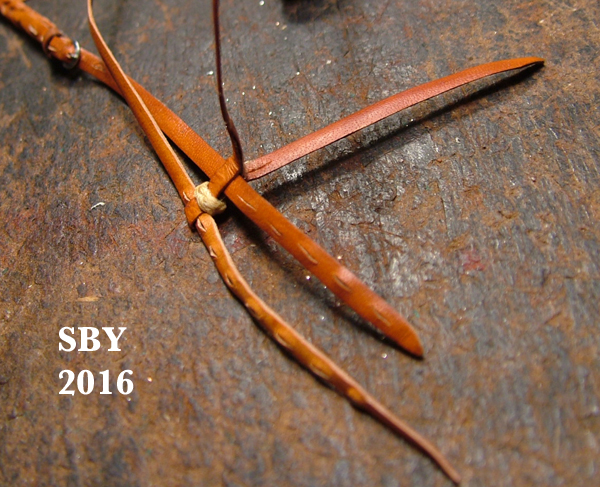
Ricky's photos clearly showed eight passes of slit braid, so I didn't want to add more.  But have too little of that lovely cheek braid??  What was this bridle, if not that cheek?!  Where'd I goofed...?  I'd asked for the maker to cut slits at-need rather than use pre-cut ones:
I found it too exhausting to measure every little slit, and they weren't whole millimeters either, but fractions.  I decided I'd cut too cleanly and too close.  Roo leather is stretchy.  I made a 3rd and 4th cheekstrap with less tightness and perfection and went on.
The buckles are a large part of the soul of a piece like this.  These buckles are made of hammered wire (with a ferrule for the tongue base).  So little a thing as doming them makes a difference.  Can you see that they were domed: hammered into a circular hollow on a dapping block so as to have a little arching overall curve to them?  I am not speaking of the obvious curve, but the side-to-side...
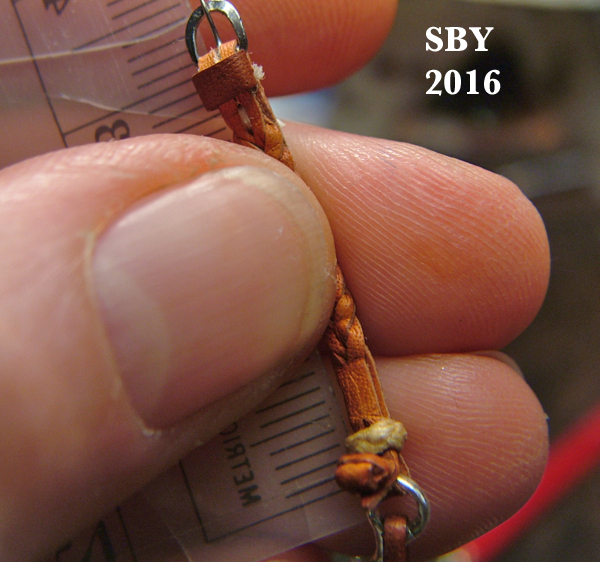
This photo shows how small everything really is.  I aimed for 30mm from top fold to bottom fold and got about 32mm (count the bottom).  I think I changed the plate to 32...
Here we're starting the browband.  The only thing missing is the throatlatch.
A shot of the making of the browband.  This does show the throatlatch.
Browband-making viewed from the inside.
A tied-knot brow, and everything is finally done.
Now for the photo shoot!  Since many of these are on our FaceBook page I'm going to restrain myself to four.
She is so photogenic.  I went through my tack collection and came up with a blazing-chestnut-red saddle (by Terry Newberry).  The blanket is named Corngold (didn't you know I named even my saddle blankets?!  Y'all oughta be glad I don't name the stable blankets!) and was finished by me in 2012.  The whole ensemble strongly suggests whoever gets this should stick with the color scheme--!!
Outdoor shot in hazy light.
Yes, this bridle, which has unaccountably taken so long to make, will be auctioned.  I shouldn't confess I'm somewhat afraid of cranking up my eBay skills, but I am.  It's been 7 years since I last auctioned tack there.  Even in my fear I want to tinker with the code and have it feature my familiar light-wheat-rawhide background shade.  I need to practice.  When everything's ready I'll notify FB and send out emails to my Notification List.  I am so grateful for your patience and support.

Having seen the Jennifer Show prizes, I can't help but think that red Rajah would look great in this bridle -- !!

Other news:
The next tack project really has to be TSII #456, the Star Wars set.  I've had so long to think about it, yet only barely designed it... ! After that I'd truly love to start working on various pieces either as part of the book (recreating existing ones for drawings and measurements) or following the elusive muse.  Blog subjects in the pipeline include Moody's Cave of Wonders, mending a blue-prism-tape saddle, a McGroarty saddle, a fifth installment of stable blankets (!) and more.  Stay tuned!


Friday, August 5, 2016

Circus Ponies & Golden Saddles

A friend has sharpened my eye for the model circus pony.  To the few ponies I shot at NAN, I'd like to add the amazing Horse with the Golden Saddle.  These two subjects have something in common: they have metallic painted tack, extensive decoration and a china bone structure.  They're supreme examples of equus fragilis.  Between them I had just the right number of photos to process and write up.  In other words,  I love 'em.

(When I say 'china bone' I am revealing my unacquainted state with porcelain. I'm not a chinahead.  But I can sometimes pun.)

With reference to the excellent blog post on her own circus pony collection (horsiemama.blogspot.com)
I have become aware of the few but fantastic model circus ponies out there.  For some reason this category, so small yet so distinct, has caught my fancy.  It's one way to control the firehose of images... and, uniquely, it is linked with this friend.  When I saw these, I had to grab them:
Kathy Moody circus ponies, in both colors!  Breyer released the whites in 1996, and the palominos ten years later, in 2006.  Ooooohhh... it's another ten years later... hint, hint, Breyer....  I just thought of that...
This deserves a close up.
Later, strolling around the showers' tables at NAN (an inimitable pleasure) I came upon them again, and decided to shoot 'as was,' in a condition of, shall we say, 'found' orientation.  I didn't have all that much time, and I wasn't about to touch them.  I'm sorry I don't recall the owner.
Curiously, I did try rotating these pictures so the horses were right side up.  But it did not work on the above shot.  They appeared to be falling off the blanket.  Something about the lighting insists they be shown as I saw them.
As for the two rearing ones, well, see for yourself.  Here they are as I shot them:
Here's my first try.  "Oh splendour, Dive not into the sea..."
Third try:
Still getting a bit of stretching distortion on the palomino's forelegs, but it's acceptable.

Seeing the two colorways side-by-side is revealing.  I love the pearlescent mane and tail on the blue.  The cinch is different, not just in color but in arrangement.  And I would have missed the gold bands on the red's forelegs... metallic detail which is missing on the blue palomino.

I have only one other shot of the blue-decked Donna Chaney dapple-grey circus pony, but it is a perfect transition to my next subject.
I have looked up this class.  At first I thought it was a UK-made china class, but it's a custom glaze workmanship color class:  greys.
I had known about the Horse with the Golden Saddle through Liz Bouras.  The owner of this iconic and stupendous piece is Colette Robertson.  I never thought I would see one in person.
My first glimpses:
Oooh  lah  lah...
 I think I can safely say 'there are no words!'
Up close.
This is about as close to Pegasus' golden bridle as I've seen in the hobby.
Kneeling is obviously the thing to do:
No amount of detail is too much for such a king.

1608.16  The owner has given me permission to include most of the text on the page next to this horse, so I'm adding it in later:
"The Horse With the Golden Saddle
"Hilal" sculpted by Pamela DuBoulay

This sculpture depicts an Arabian stallion with authentic antique ceremonial accoutrements.  The saddle is portrayed as embroidered with golden thread and encrusted with colored glass stones.

Made from the finest bone china, "Hilal" stands on a base.  This fabulous piece is inidividually hand made to order and produced and finished by the best British craftsmen.

That being said, the original edition of 150 has never gone into production.  Pamela comissioned A Avalon Ceramics of Herefordshire, England, to produce her sculptures.  Shortly after this the factory closed.  She then commissioned Alchemy Ceramics of England (Mark Farmer) to continue on with the production, but he went out of business shortly thereafter.

Now Donna Chaney of Animal Artistry is trying to produce these.  They are very challenging due to the complexity of the piece, but at least eight have been successfully produced.  Donna estimates that the edition will close at 50 pieces."

seen at NAN 2016, owned by Colette Robertson.

I think I have viewed the highest of the high.  

This may be a ridiculous shot and not best flattering!  But it does capture the attitude of some of us to these horses.  With apologies to Sue Rowe. 
 Next up:  probably tack!


Saturday, July 30, 2016

Faces at NAN

 I brought home 1483 pictures from NAN.  The question becomes not which ones to share, but which ones of which part of which categories of my style of shooting to share first?!  That 1483 number is not counting the deletes, OR the ones taken as official photographer of the champions and reserves.  Today's short answer is "close-up portraits of horses and model people."

    For several years now I have known my shooting style was developing (o pun) into something individual.  Wanting to document an entire show, I learned to capture whole tables at a time by shooting diagonally across the ring.  Then I'd zoom in on individual horses in that class that caught my eye.  Sometimes I'd further zoom in on their faces, for a portrait.  It's amazing to discover I often selected the winner many minutes before the judge did.
    I would get 'atmosphere' shots, views of the setting.  I would get tack shots, close up, of pieces that grabbed my eye, for myself of course.  I wanted to get people shots, but that turns out to be extremely difficult.  Later I hope to share some of my successes along these lines.  For today, I first organized my 1483 chronologically:  seven hundred + shots on Tuesday, four hundred+ on Wednesday and 373 on Thursday (I guess I was running out of steam).  Then, quickly viewing, I evolved categories:  hall shots, prize shots (the championship table), portraits (close ups of individual models), people (76+), tack details, and 4 miscellaneous categories, which for this show turned out to be Horse with the Golden Saddle, Circus for Lynn, the Pintaloosa Foal I fell in love with, and the Marwari Costume.  If time permits, I'll share these too. 

But back to the faces.  It's the easiest thing in the world to snap the shutter on a model horse at NAN.  Most of my shots are tables or parts of tables or groups of models or individual models.  It's a little harder to get right up close to their faces and really focus in on who they are.  Out of my nearly-fifteen-hundred shots, only about 30+ are portraits... ... about two percent.
    I loved these two harness portraits because of their eyes.  I don't really know who the owners are; info welcome.
At first I pulled the OFs.  The mythical bay Alborozo is in the building!
I do love the chinas.  I'm sure my love of glossies is influenced by them.
What an expression!!  Who could resist??!!?  "Face melts"
Here's one that won after I shot him.  This must be a Mink.
Some of these chinas are perfect beyond belief.  I can't quite explain going quite so snap-happy around them, except that I've never been allowed to collect chinas myself, on the grounds that I would certainly break them.  Now that I'm old enough not to break them, my house is not exactly safe for them, and high-dollar models make both me and my husband nervous.  I do have four chinas, yet one of them broke an ear already.  The subject will have to be addressed some day.  Meanwhile I blaze away.
Speaking of perfect, something happened when I spotted The Horse With the Golden Saddle.  I could hardly believe what I saw seeing.  Several other photographers did the same thing, bowing and fawning and staring and shooting away (is this paparazzi?!) so I know I'm not alone.  Owned by Colette Robertson.
Yet there were horses in the hall that moved me even more, in a way I did not expect.  I am old enough to remember when this remarkable work of art was news:  It's Lu Heater's Acoma!  I never thought I'd see him in person...
This horse led me to choose, somewhat naturally, this fellow's portrait:
The beadwork alone is astonishing.  Add in the horsehair tassels and the feathers (ermines? they look like feathers to me!).  But it's his expression that speaks the most.  From here on, I would choose those human portraits I could actually shoot, without impingeing too much on someone's privacy, or struggling to catch them standing still (which is really hard with the living kind)...
    I had rarely focussed on their faces before.
This costume, which almost defies belief, was made by Cary Nelson.  I could do a whole post on it alone.  I am pleased to report it did win Champion.
How about this face??  We are all so familiar with this horse, known today as the Classic Arabian Family Stallion.  But I almost never have gotten to see this face...
It seems appropriate to wind down with this fellow.  Memories of the song 'Minstrel Boy' ring through my head (Roosevelt used it as his theme song), not to mention Night at the Smithsonian (movies featuring him), when I see him.
It's such a good likeness.  Dang! -- almost reminds me of Indiana Jones...
The true last word of this post, I believe, should go to this young lady.  Thank you people.