Saturday, January 14, 2017

FL Birds from the Canoe

 The number of bird pictures I took during our recent Christmas vacation in FL was amazing:  More than ever before.  The convenience of our little canoe camera, a Canon Powershot SH610 HS, is surely to blame.  Some trips we feel like taking pictures; some we don't.  This time we did but even so only about half our runs were covered!  Sorting out the mass of pix (over 600) into 'which river when,' it dawned on me.  Birds were present every run.  What did you expect from birdwatchers and a model-horse-show-photographer?!  This post will loosely follow chronology.
I will add two cents about slackwater canoeing:  It's a sport for folk who like movies in slow motion; and a good run bears a strong resemblance to a grand old-fashioned amusement park ride.

We'll start with Haw Creek, northeast of Ocala.  This shot (above) is as I took it.  Most shots in this post were taken from our canoe, on the water; if not, it's noted.  The blue is a Little Blue Heron and to his left is an immature Yellow-Crowned Night Heron.
Birdwatchers + canoe + Powershot = PhotoShop!  Below is the best one of the Immature Yellow-Crowned, cropt and sharpened.  Haw Creek was about half covered with duckweed, and required faith to launch.  We did eventually find clear water.
Here's the Little Blue Heron, zoomed and sharpened:
Next was the St John's River.  Along with the Withlacoochee this is one of the longest rivers in Florida... by no means fully canoe-able!  One of our favorite St Johns tributaries is the Econlockhatchee (which I've blogged on earlier).  These Sandhill Canes were photo'd by George while walking on the floodplain of the St John's near the Econlockhatchee.
The Sandhill Crane is one of the most majestic birds in FL.  They are always easy to identify because of their call, a rolling grinding mutter that sounds like "grullyo, grullyo."  For you horse color fans:  the Spanish word 'grullo' comes from this bird.  The color of the horse was exactly the gray color of the cranes.
This shot is cropt and zoomed:

  Next, still on the St John's, we were out south of the Jolly Gator marina off Hwy 50, heading for Puzzle Lake.
At first just white dots, these eventually turned into birds.
 Looks like a couple of White Ibis.  For some reason we started calling the many Ibises "Ibitz" and this nickname stuck for the rest of the trip.
A fine Common Egret (Great Egret).  This shot has been cropt and straightened; I'm still working on getting my horizons level.
We generally park for lunch by letting the wind blow us against a shore somewhere.  Canoeists are very aware of wind, especially when their craft weighs only 57 pounds.  During lunch that day I spotted a familiar color pattern on a post.  It took about 5 tries to capture this Bald Eagle:
The Econlockhatchee is one of the few places where you can step right out onto the prairie.  With the sun behind us, we caught a rare double portrait.  : )
On one of our Econlockhatchee runs, we found a great many Ibitz. 
Note the steep banks of the Econ.  This river varies from feet-high banks to almost no bank, and back again.  It's amazing considering the cows.  Speaking of cows, I believe this is a Snowy Egret.
Where there are cows, there are usually Cattle Egrets.  Although we saw a lot of them I was unable to photograph more than a few.  I was also trying to capture the colors of the cows.  There was a black bay I enjoyed (on left).
 Since we were below their radar, we saw mostly just heads.
The variety of horns and body shapes leads me to state that, at least in this part of the St John's, the cows are Brahman crossbreds;  in other words, mutts.
This day was a long one and we were out until near sunset.  I got lucky and shot a fine Tricolor Heron in the downsun golden glow.
These used to be called Louisiana Herons.  He was fishing enthusiastically.  I have sharpened these 3 shots but no other processing.
When you're in a canoe all day, Nature is your only entertainment.  And for whatever reason, wherever we floated on this trip there was a great abundance of Tricolor Herons.
There were also gators, but I didn't get a single shot of one this time.

There is a 4-mile dirt road along a canal at the mouth of the Withlacoochee, where it reaches the Gulf.  The mighty With, we call that river.  These 2 pix were taken from a beach accessed by the road.
 Those long grey strips of rocks are oyster bars.  They indicate the presence of salt water.  The oyster shells are hard as steel and sharp as diamonds and they can cut our canoe like so many Japanese sashimi knives.  We have gone canoeing in oyster territory, but not this trip.
What should we see here but a couple of Oystercatchers (black and white with a red bill), along with some Willets.  Here's a Shopped closeup:

Every Florida canoe trip includes some new rivers we haven't tried before.  One such this trip was the Tomoka, off the east coast north of Daytona Beach.  The weather was cloudy but it didn't rain.  I have brightened up these Pileated Woodpecker shots.  Capturing these hard-to-shoot birds was a high point for me.
 In the first pic (above) there is a Tricolor Heron in the lower right.  I told you they were common...
Such a characteristic pose!  I cropt and zoomed and brightened on this last:
This shot shows the surroundings in which my Pileated shots were taken, and the distance we were from them.  The bird is barely visible on the right side of the central trunk, just below the hole.

On the same Withlacoochee canal dirt road, we saw a Black Crowned Night Heron in a huge juniper bush.  Here is where my sense of time gets kind of hazy and so does my focus!  At first the bird is all but unfind-able.  Look in the lower right quarter of this unretouched shot:
Here I'm cropping and zooming, but he's still hard to find.  Look in upper center:
Finally I Shopped the best one up close.  At that distance there's some graininess, but it's still identifiable as a Black-Crowned Night Heron.
For some reason, Night Herons of both flavors, Black-Crowned and Yellow-Crowned, were practically common on this trip.  Usually they are rather rare birds for us.  I have no explanation.

This Yellow-Crowned was visible on a short trail in the Savannah Wildlife drive.  Other birders pointed him out to me.  There was supposed to be a reflection in the waters below, but I missed it with the camera.
 A close up.  The Yellow Crown looks almost fuzzy --!
Our next destination was Kings Bay, part of Crystal River on the west coast.  I am positive it was 2017 by now.  There will probably be another blog on this run because that's when the only model- horse-in-the-canoe pix of the trip were taken.  But for now, enjoy this driveby of an Anhinga and two turtles.  I like turtles -- very useful for a Florida canoeist!
 Kings Bay gave us one of our best-ever encounters with a Yellow-Crowned Night  Heron.  (I told you they were common, along with the Tricolors!)  This shot is unprocessed except for lightening:
Without a doubt, this is my best shot of a Yellow-Crowned.  And about the closest I've ever been to one, too.

He did not seem to be afraid.  That's one thing about canoes and kayaks:  they're quiet and slow, and birds don't seem to be alarmed quite so much.


Near the end of our trip we found ourselves in Dunellon, the jumping-off point for Rainbow Springs and more stretches of the Withlacoochee.  The With here is residential.  Looking at people's waterfront property is some of my favorite paddling activity.  Here is a fine male Anhinga on a dock post.
 Not far from the municipal boat launch ramp in Dunellon I got two birds in one shot:
 A very nice Great Egret,
And an Immature Little Blue.  Yes, the young Little Blues are white.  The differences between them and other white herons lie in the colors of the bill and feet.
 All this and no Green Herons!  Nor Kingfishers; Osprey, Vultures, Glossy Ibis, Palm Warblers or any of the multitudes we saw but did not shoot.  Safe to say birdwatching is a sport one can pursue just about anywhere with just about any level of determination.

A last rara avis, which I can't resist putting in, is this magnificent Wooden Golden Eagle, spotted on someone's staircase deck in the backwaters of the With near Dunellon.
I hope you've enjoyed this tour of north-central Florida's birds seen from a canoe.

Saturday, December 17, 2016

Felts For Foals: Blankets 5

My fifth post on Stable Blankets features felt foal blankets.  I made these in the late 1970s and they have gone a long way towards solving my CollectAs blanket problems!  Way way back when these blankets were made, my herd had only the five colors of FAFs.  I believe that the extra blankets were made for Running Foals, of which my sister had a couple.  My extra App FAFs appeared 11 years and 18 years later, respectively.

These felt blankets were made by me between 1973 at the earliest (the year Breyer introduced their felt blanket kit)(see below) and 1983 at the latest, a year after I graduated from college.  I certainly remember learning how to sew, on a Kenmore sewing machine (new in 1966), making these.  Velcro was a new and rare thing; all the snaps were sewn by hand.  The pile of blankets has been stuffed away all these years (33 to 43 years depending!), along with many old costumes, coolers, and other toy horse goodies.
 Speaking of old costumes, let's take a closer look at the one with the white pom-poms, glimpsed at the lower left.  It was made for this mare:
I'm not sure if this 'bridle' goes with this costume, but I do recall hand-sewing every one of those sequins... pearl-colored, similar to what we would call today "AB" or Aurora Borealis.  In person you can see a faceted jewel (glass) sewn into the center of the breastband.

When I bethought myself of the possibility of CollectA-size blankets in this ancient treasure trove and dug them out, I began remembering that the colors had significance.  Felt colors were assigned to individual horses, who became associated with those blankets.  Some of them have names written on them.  It's rather obvious from the above pile which colors King got to wear.  : )

Over so long a span of time, my herd's ruling hierarchy has of course changed, but there has always been a royal family.  To this day, King's son, Tesoro, the charcoal FAF, wears only light blue - the lightest of light blues.  The slightly darker light blue was assigned to his forever-girlfriend, Payasada, the white FAF.  (If you can tell these names came from Van derVeer's Hold the Rein Free, more points to you!)  Tesoro gets to permanently wear his own costume halter, made for him somewhere in the 1990s (I think).  Other ornaments (Windy's necklace) were made (by me) from floss, only for Arabians, inspired by Marguerite Henry's great classic book, King of the Wind.
The palomino, Sun Lemon Sunflower, always wore green.  The bay, Windy, got red.  Lucky, the first Appaloosa (shown in yellow), was assigned dark blue, and here the story takes a different turn.  I found no dark blue foal felt blanket of this style.  Instead, I found two ancient foal blankets which I dimly remembered making from the dawn of time:
See how far down they wrap around?  The edges almost meet underneath.  These blankets look like they were made from another method, one without regulation paper; perhaps they used cloth patterns?  They're a lot more... customized.  Even then I was inventing...  I certainly remember the Breyer blanket kit that started all this.  It gave me a pattern I am sure I adapted and resized and re-used for the majority of my felt blankets.  I still have that pattern ... and that blanket.
On the inside of this most ancestral of all my blankets is written the name, "Snowman."  This was the name of my sister's white FAS, no doubt influenced by the Tony Palazzo book, which we had.  This is, indeed, Janet's Snowman!  Why he has stayed, and my own white FAS, named Pine, has left over the years, is one of those painful historical observations.  Normally I don't regret selling a horse, but I do regret that one.  It happened in 1981 and was in the Denver area, so the chances of Pine still being in Colorado are somewhat better than nothing.

Kits and books!  Look where they've led just one girl...

Today, Lucky's dark blue blanket is worn by my only china Trad foal.  I named him Gillantown. This name, inspired by Gilen, is of an actual central PA town.  Gillantown gets to wear it more or less permanently, as he is fragile (already broken once - thank you Jenn Danza for repairs!) and in need of some padding, around so many plastics.
Oh the untold stories!  This blanket and one of the reds have got bands of reinforcing see-through ribbon with white glittery edges, clearly decorative, hand sewn on their straps.  Was this an attempt by a young girl to prevent the felt from stretching and shredding?  Almost certainly it was.

Up to this point my CollectAs have suffered through the most ill-fitting of blankets.  Here we have, left, a 'Blitzen' blanket, made for a Running Foal, and "Fightin Fillies" made for the Miniature Horse mold, Midnight Tango:
(Thank you Helen.  Although I saw this Fillies blanket stain your horse pink, it has not marked any of mine.)
Don't you think Breyer's much-issued Classic Foal blankets would fit?  Well ... sort of ... :
They fit the Dartmoor Pony just fine.  It's just that most of my CollectAs are not ponies!
But now, with the FAF felts, everybody is much better fitted.  The blankets are still a bit big:
Curiously I found myself assigning Tesoro's blanket to the leader of my herd (his name is Akator, from the Indiana Jones movie).  Payasada's, representing both female and second-in-command, went to my favorite married mare, Halite.  (Who Akator's wife is is currently in dispute.)  Oddly, the rest of the traditional color assignments fell to the wayside, and horses just grabbed what they liked!  I particularly like the yellow on the cremello Akhal Teke, whose name is Creamsicle.  They don't all have names, but this state cannot last forever.

Another state that cannot last is that of my CollectAs having no blankets made especially for them.  I predict, given this tackshop's long history, it will be a race between tack and blankets.  And I can only be very, very grateful I can make them both.

Speaking of grateful, Thank You to the stopped-counting-hits... : )


Sunday, December 11, 2016

Forest Primevals

 In October this year, canoeing on Raystown Lake, we encountered a log too big to believe.  It was eerie, mysterious and inspiring.  When one canoes enough hours in enough places, one comes across such things... but they cannot really be captured on film.  This post will explore what pix we do have of some memorable primeval giants we have been fortunate enough to find in the past few years.

In the fall, Raystown Lake is drawn down.  For whatever reason (possibly we'd just never been out so late in the year)(global warming!) the water seemed drawn down farther than we'd ever seen it, at least 6 feet.  This exposed many parts of the shore which, naturally, we'd had no idea were there.
When I first saw the log, on the far side of Aitch bay, I thought it was a rock. 
 It had the same horizontal layers, rough and etched, well-weathered, and the same color as a rock.  All around us were rocks like that...  As we drew closer, my spine started to tingle.  Surely not.  No, it couldn't be...
Cautiously we approached, as one would approach a sleeping dinosaur.  Not a rock.  Photos don't do it justice.  It was huge.  Part of it was still under water.  I was almost frightened:  a feeling of great awe, amazement and profound worship came over me.  It must have been 500 years old... when it was alive.
Where could such a forest giant have come from?!?  We'd been all over the Lake, and none of the trees in sight were anything like this.  After long discussion we decided it had washed down from more northerly tracts.
 In the afternoon, returning, the light stuck the log entirely differently.  The size was still evident when compared to trees around it. 
 To think it had been there, underwater, for who knows how long!!
 
In the way of blog posts, once I got started on this one I remembered other giant logs and stumps we had found.  Deep in the southern woods are mighty cypresses that dwarf their neighbors.  The study of size distribution in cypress trees would be very interesting.  The largest ones are found singly, with long distances between them, yet with many other smaller cypresses nearby.
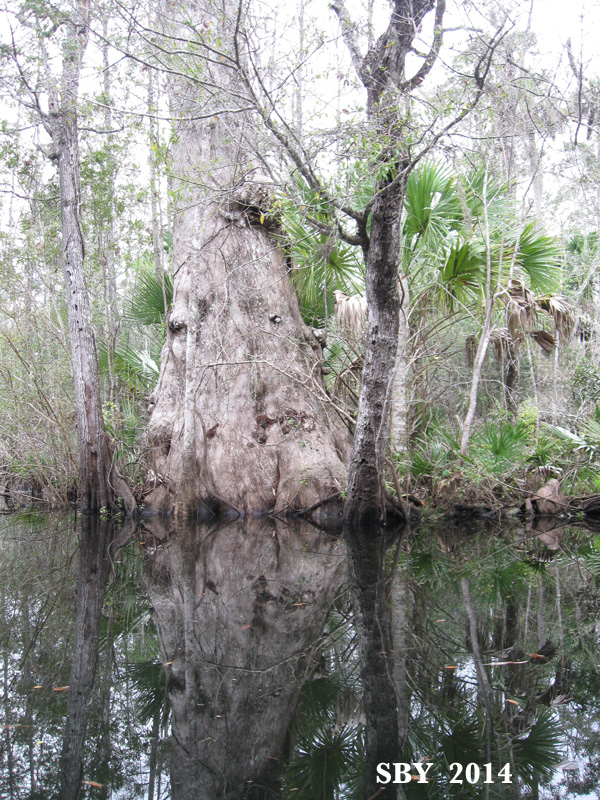
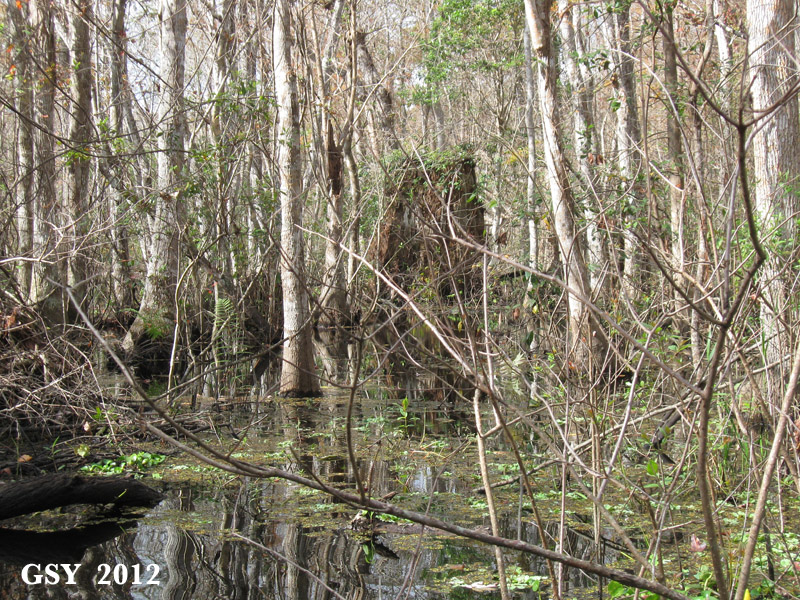
Here's one in Tate's Hell tract, in the lower central panhandle of Florida, seen in 2012.
You do indeed see some strange tree forms out in the swamps.  It's part of the fun!  (I could do a whole post on "strange things I've seen from a canoe."  Someday!)   This one is also from Tate's Hell State Forest, same trip:
A trunk both large and unusually formed.
And yet this is by no means the largest cypress I've ever seen.  (nor even the most suggestive -- not by a long shot!)

This stump is in Dead Lake, Cypress Creek, FL.
As ever, it's hard to estimate the size.  End on, our canoe could hide behind it easily.  This view gives a dim idea of the enduring qualities of the wood:  it takes at least a hundred years for the stumps to decay.  Some take longer.

To canoeists the word "waterlogged" is not fanciful, but a very real phenomenon.  We are also well aware that light refraction happens.  Which is why it was all the more amazing when we came across this:
Didn't I say the biggest logs were hard to photograph?!?  They're about 2 feet below the surface of the water.
I tried and tried, but the edges of the giants could not be photo'd clearly.  That's my paddle for scale.  The trunks were easily as wide as our boat.  These logs (there were two) were found in the Wacassassa River, in central western Florida, again in 2012.
Another find on the Wacassassa River, two years later, was this one.  Sometimes they don't look as big as they are, due to smaller neighbors.  In this case we had to draw back a good bit just to fit it in the viewfinder.
Closer...
Closer...
 All along the Wacassassa we'd seen the occasional giant stump or dead trunk... The great cypresses (genus Taxodium) can live for hundreds of years.  (cypresswood.net claims up to 700 years.)  Still, when they reach a certain height and size, rearing up out of the forest, they tend to get "topped," have the top snapped off in hurricanes.
 I was blazing away.  We had never before been able to get this close to one of the truly giant primordials, yet here was one right on the riverbank. 
Decent, fully grown trees next to it look like kindling sticks. 
 We tried very hard to photo George next to the trunk, to provide some scale.  Alas, being in the canoe limited our efforts.  But you can see how truly enormous this one was.
What might not this stately old trunk have seen?
The cypresses are so individual in their shapes, sizes and histories.
The stump that meant the most to me (at least until the Raystown one) we saw in Blue Cypress Lake, in east central Florida, over Christmas in 2012.

In the swamps we frequent, the largest trees are invariably stumps.  Mostly these were cut in the 19th century (1800s).  The method of harvesting was to girdle the tree and then leave it for up to 2 years.  The tree died and then dried out.  Fresh cut cypress was too heavy to float. (Thank you cypresswood.net.)

We first saw it through a screen of swamp jungle, slowly nosing our way into the headwaters of the mighty St Johns river.
 Gradually it became clearer.
Once more, photos don't do it justice.
I found myself staring in utter wonder.  Canoeing does send me into a trance state, but this was something else again.  When that tree had been a sapling, my country hadn't even been born.  That tree's species had evolved to deal with Dinosaurs.  Or so goes one good argument as to the knees...!
It was tough to get a photo with a human being for scale close to it.  We had to settle for some distance away.
I will stop here with the shot of the shooter!
I have always been fascinated by old growth, be it trees or antlers.


There are a great many subjects I'd love to blog about; and the longer I wait, the longer the list.  Model horses, collections and model tack are just a few.  What stops me blogging are various chores and projects, some of them required maintenance and others seasonal.  (For instance, Christmas vacation.)  But I haven't forgotten this pleasure; rest assured I will return as soon as I can.

P.S. I truly have No idea how I've garnered 2 million hits.  I wish it would stop.