In October this year, canoeing on Raystown Lake, we encountered a log too big to believe. It was eerie, mysterious and inspiring. When one canoes enough hours in enough places, one comes across such things... but they cannot really be captured on film. This post will explore what pix we do have of some memorable primeval giants we have been fortunate enough to find in the past few years.
In the fall, Raystown Lake is drawn down. For whatever reason (possibly we'd just never been out so late in the year)(global warming!) the water seemed drawn down farther than we'd ever seen it, at least 6 feet. This exposed many parts of the shore which, naturally, we'd had no idea were there.
When I first saw the log, on the far side of Aitch bay, I thought it was a rock.
It had the same horizontal layers, rough and etched, well-weathered, and the same color as a rock. All around us were rocks like that... As we drew closer, my spine started to tingle. Surely not. No, it couldn't be...
Cautiously we approached, as one would approach a sleeping dinosaur. Not a rock. Photos don't do it justice. It was huge. Part of it was still under water. I was almost frightened: a feeling of great awe, amazement and profound worship came over me. It must have been 500 years old... when it was alive.
Where could such a forest giant have come from?!? We'd been all over the Lake, and none of the trees in sight were anything like this. After long discussion we decided it had washed down from more northerly tracts.
In the afternoon, returning, the light stuck the log entirely
differently. The size was still evident when compared to trees around
it.
To think it had been there, underwater, for who knows how long!!
In the way of blog posts, once I got started on this one I remembered other giant logs and stumps we had found. Deep in the southern woods are mighty cypresses that dwarf their neighbors. The study of size distribution in cypress trees would be very interesting. The largest ones are found singly, with long distances between them, yet with many other smaller cypresses nearby.
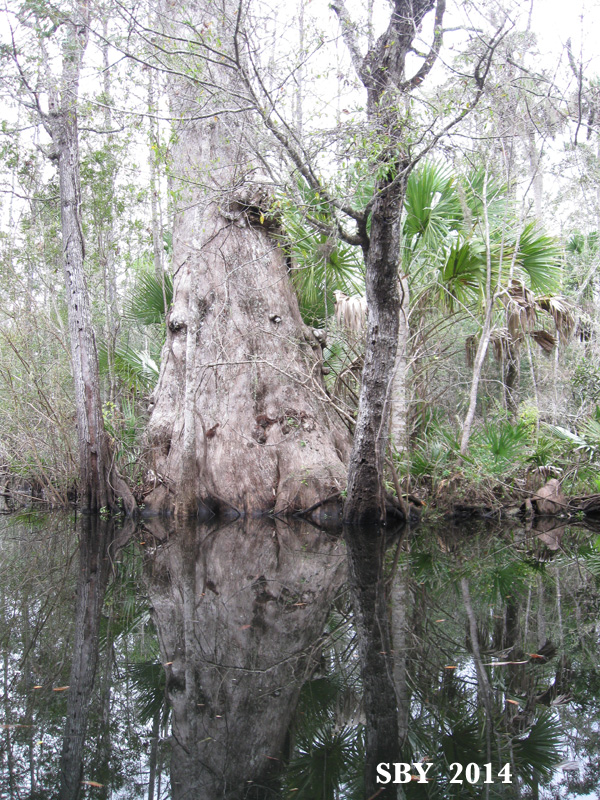
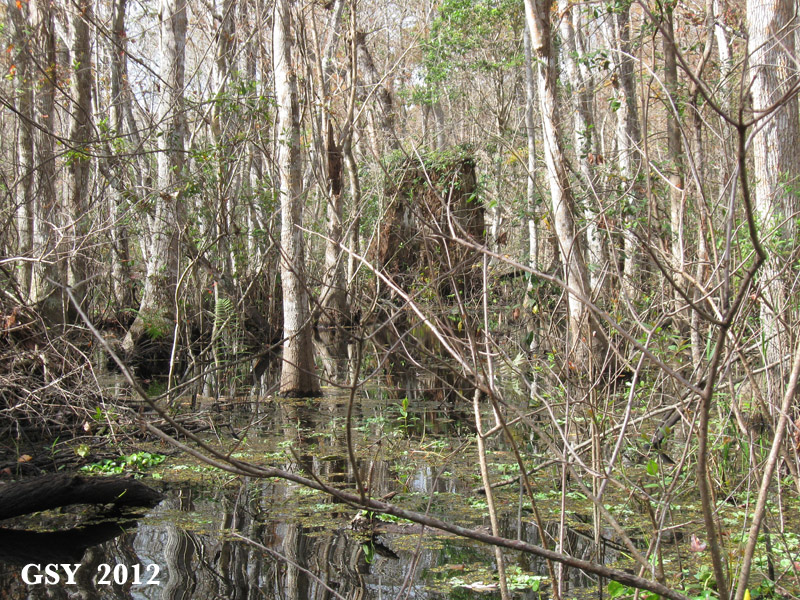
Here's one in Tate's Hell tract, in the lower central panhandle of Florida, seen in 2012.
You do indeed see some strange tree forms out in the swamps. It's part of the fun! (I could do a whole post on "strange things I've seen from a canoe." Someday!) This one is also from Tate's Hell State Forest, same trip:
A trunk both large and unusually formed.
And yet this is by no means the largest cypress I've ever seen. (nor even the most suggestive -- not by a long shot!)
This stump is in Dead Lake, Cypress Creek, FL.
As ever, it's hard to estimate the size. End on, our canoe could hide behind it easily. This view gives a dim idea of the enduring qualities of the wood: it takes at least a hundred years for the stumps to decay. Some take longer.
To canoeists the word "waterlogged" is not fanciful, but a very real phenomenon. We are also well aware that light refraction happens. Which is why it was all the more amazing when we came across this:
Didn't I say the biggest logs were hard to photograph?!? They're about 2 feet below the surface of the water.
I tried and tried, but the edges of the giants could not be photo'd clearly. That's my paddle for scale. The trunks were easily as wide as our boat. These logs (there were two) were found in the Wacassassa River, in central western Florida, again in 2012.
Another find on the Wacassassa River, two years later, was this one. Sometimes they don't look as big as they are, due to smaller neighbors. In this case we had to draw back a good bit just to fit it in the viewfinder.
Closer...
Closer...
All along the Wacassassa we'd seen the occasional giant stump or dead
trunk... The great cypresses (genus
Taxodium) can live for hundreds of years. (cypresswood.net claims up to 700 years.) Still, when they reach a certain height and size, rearing up out of
the forest, they tend to get "topped," have the top snapped off in
hurricanes.
I was blazing away. We had never before been able to
get this close to one of the truly giant primordials, yet here was one
right on the riverbank.
Decent, fully grown trees next to it look like kindling sticks.
We tried very hard to photo George next to the trunk, to provide some scale. Alas, being in the canoe limited our efforts. But you can see how truly enormous this one was.
What might not this stately old trunk have seen?
The cypresses are so individual in their shapes, sizes and histories.
The stump that meant the most to me (at least until the Raystown one) we saw in Blue Cypress Lake, in east central Florida, over Christmas in 2012.
In the swamps we frequent, the largest trees are invariably stumps. Mostly these were cut in the 19th century (1800s). The method of harvesting was to girdle the tree and then leave it for up to 2 years. The tree died and then dried out. Fresh cut cypress was too heavy to float. (Thank you cypresswood.net.)
We first saw it through a screen of swamp jungle, slowly nosing our way into the headwaters of the mighty St Johns river.
Gradually it became clearer.
Once more, photos don't do it justice.
I found myself staring in utter wonder. Canoeing does send me into a trance state, but this was something else again. When that tree had been a sapling, my country hadn't even been born. That tree's species had evolved to deal with Dinosaurs. Or so goes one good argument as to the knees...!
It was tough to get a photo with a human being for scale close to it. We had to settle for some distance away.
I will stop here with the shot of the shooter!
I have always been fascinated by old growth, be it trees or antlers.
There are a great many subjects I'd love to blog about; and the longer I wait, the longer the list. Model horses, collections and model tack are just a few. What stops me blogging are various chores and projects, some of them required maintenance and others seasonal. (For instance, Christmas vacation.) But I haven't forgotten this pleasure; rest assured I will return as soon as I can.
P.S. I truly have No idea how I've garnered 2 million hits. I wish it would stop.