Sunday, March 13, 2016

Blanket Collection 4

Collecting stable blankets has been so much fun for me I haven't stopped.  Most of them have taken up residence on my horses.  Protecting the horses from dust turns out to be secondary -- we simply have long since passed the stage of everything fitting in the one shoebox.  Even with foals, Classics and Buffaloes, I'm not going to run out of deserving horses...  ...yet.

The title of this post indicates three previous posts or chapters.  I'm a bit ashamed the first one is so hidden; you have to scroll down to the bottom of Three-strands-at-once in order to find it.  The second chapter is much more standard:  My Blanket Collection posted December 2014.  Two months later came the third installment: Blanket Collection Part 3.  Clearly we are off and running on a sustainable path!!  And how much I've learned...

I want to start with Breyer's great Canvas blankets, the first finished blankets ever carried.  (Breyer's felt kits, issued in 1971-1974, were unassembled.)  The initial Canvas offerings were #3915 Blue and #3935 Red, from 1977 through 1979, three years.  In 1980 two new numbers were issued: the Red was given #2380 and a Brown was given #2360.  The Red was carried for one more year, 1981, and then blankets were dropped, until 9 years later.  (One wonders whether they were good sellers.)  However I can attest that while Breyer's Canvas blankets are rare on the secondary market, recently there have been more available.  Thanks to this groundswell of population I have been able to amass all three colors of these grand old pieces, in various conditions!
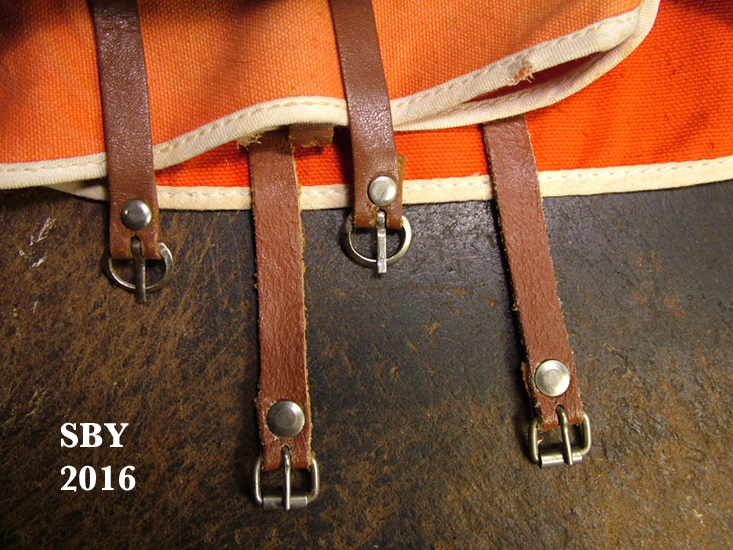
The Canvas blankets were equipped with genuine leather straps, white binding, rump darts and grommets at the chest.  The front lacing, of leather lace, is often missing.  (Or in the case of fitting a Fighting Stallion, missing and won't reach anyway.)  One noticeable feature is the shape of the buckles: some had square roller buckles and others had half-round tongue buckles with no roller.

 I'm not positive about this, but it stands to reason that the square buckles came first.  One of my Reds has square buckles (on the Woodgrain) and the other has the cheaper, ligher round buckles.  I'm guessing the square buckles, big and strong, with their heavy rollers (easy on the leather) were part of the first wave of blankets, '77-'79.  The lighter, thinner buckles, which cause more scraping wear to the leather, must have come later ('80-'81). In general, this feature of a company's history can be used to help date pieces:  expensive products and parts are often followed, in later years, with cheaper materials.

In my Blanket Collection post I mentioned my Brown Canvas blanket.  Here it is, with a second piece to compare:
As noted earlier, the long body shape of these blankets went better with popular older molds like the Fighting Stallion, Indian Pony, San Domingo, Trakhener, Hanoverian, Running Mare, Proud Arab Stallion, and Stretch Morgan.  Both these blankets have the half-round buckles, consistent with a 1980 production.  I love how the faded Brown looks just like milk chocolate!

 The degree of fading, so noticeable in these shots, has (believe it or not) nothing to do with the blanket's age.  Try exposure to sun over 30 years!  It's sheer coincidence that one of each of my colors of Canvases is faded.

Given that the Brown was produced for only one year (1980), I was a bit surprised at how easy they were to acquire on the secondary market... and how hard it was to find a Blue.  (Maybe people didn't like Brown.)  I was obsessing on Blues.  I had seen several go by on eBay and missed them for one reason or another.  Worse, I had a mystery to solve.  What color were they, really?  Were they a deep dark navy blue, almost black?
photo taken from eBay
Or were they an unbelieveable brilliant sapphire-sky blue?
photo by grusman off eBay
The Reds and Browns hadn't given me a problem like this!!  And I simply couldn't remember.  You'd think I had a clue with the Blue Turnout Rug... no.  But at last, on January 26, I was able to snag not one but TWO beautiful Blue Canvas Breyer blankets!!
And hey presto, my color mystery was instantly swallowed up in another mystery:  that of the binding.
 My eyes popped with the second Blue:  the binding wasn't white at all, but a slightly different blue.  This was a poser!  It wasn't something someone had done after market... it was a true Original Finish.
We know Breyer sometimes substitutes products, releases things not in the catalog, makes changes and alterations and just generally drives collectors crazy trying to figure out what happened.  I could only conclude that this Blue was the earliest of all Canvas blankets, when Breyer was still exploring production options.  They must have tried it out and made enough to sell, but not enough to carry for the full 3 years ('77-'78-'79).  Both these Blues have the square buckles.
I do like them, even though they are somewhat stiiff and heavy compared to other stable blankets.  The leather lace at the chest is too precious to unfasten or risk losing, so I oiled it and now leave it strictly alone.  Noticeable on the Harley D is that the near grommet has come loose from the fabric, but since I'll not untie the lace, it won't get lost.

Speaking of obsessing on blues, my next catch was of a pair of blue pieces that took my breath away.  One was a third Blue Turnout Rug.  Setting all 3 Turnouts together shows how truly different the colors can be:
I am convinced the rightmost two (on the palomino & buckskin) are faded and unfaded versions of the 'plastic' leather strap variety of this blanket (model #2806, 2000-2003).  The leftmost (appaloosa) is the 'leather layer' variety, the (presumably earlier) one where a thin grain layer of leather was bonded on top of plastic straps.  I am assuming this transition occurred between the Green Turnout ('95-'99), which has leather straps, and the plastic Blue ('00-'03).
Also interesting are the changes of the tiny Breyer tag:  gold letters, white letters,  or dark overall.
I never used to pay attention to the tags before!
And my second piece?  Of all things, a Breyer Quarter Sheet from 2000-2003! 
Photo taken from 2002 catalog
I had never seen one before, but I fell in love on sight.
 
 The only other example of a Breyer Quarter Sheet EVER, that I'm aware of, is the one being currently (2016) worn by the Classic American Pharoah.
I had totally not realized how big this piece was.  Even on the biggest Trad I've got, the huge Cleveland Bay, it appears large.  (Probably because I'm not positioning it right -- I'm Western!)  This particular example has a small tail strap snap, almost certainly added by the owner:  it has careful sewing, and one isn't shown in the catalog.  EDITOR'S NOTE:  Later evidence from eBay shows that this strap is in fact Original Finish.  Catalogs ain't perfect!  The underside is a gridded rubbery material.
It is very heavy-duty, thick and fuzzy on the outside, and could probably turn rain.
I couldn't resist tacking up Mighty Joe Young with a Kim Cassida saddle.  (Bridle by me.)

We can't leave the blue blanket category without one last example which is now in my hands.  Don't think I have all four colors of Quilted-with-Hoods; I only have the first and last.  Here's their numbers and years:
#2803  2000-2003  Dark navy green with blue binding
#2808  2004-2009  Deep rich purple with black binding
#2040  2010-2014? Turquoise with deep pink binding
#2080  2015-?        Light Blue Plaid with blue binding
It's embarrassing to admit I'm not sure when the turquoise one was discontinued; and even more to admit I don't have solid evidence on the Plaid.  The material matches the Going to the Horse Show set currently (2016) being offered, but this lovely light Quilted Blanket with Hood, with its thin white puffed-plastic lining, is not on Breyer's website at the moment.
Compared with my oldest Hood, the straps have gotten a little narrower, and the ear opening isn't oval-shaped, but almost pointed at the ends.
But the straps are shinier, and certainly prettier, so there.
Breyer may have dropped some blankets recently, but they've issued quite a few more.  The most beautiful and collectible without doubt are the Christmas specials.  Naughty Breyer!  As if we didn't have enough already!!  In 2014 came the first of these sets, Vixen and Blixen, on a mare and foal.  These lovely blankets feature metal t-hooks, a high quality hardware, and are fuzzy white inside.  You'd think they'd read my mind!
An intriguing aspect here, to me, is that the Breyer tag is on the OFF side of the mare's blanket.  Inexplicable until you recall that the Running Mare's romance side [in the carousel sense: best presentation side] is her off side, while the Running Foal's is his near.  O.K. that's not a Running Foal shown... that's a CollectA Hanoverian stallion (still seeking his own blanket...).  I have to credit these blankets' adjustability: easy and without wrinkling, which is not always the case.
And here is the 2015 Christmas Special blanket, Eve's.  Tiny horseheads!!  Christmas colors!! White and fuzzy on the inside...
Another case of inexplicably placing the tag on the off side, until you recall that the Nursing Thoroughbred Mare, again, has her romance side on the off.
Because of a set-splitting decision by a seller, I find myself in need of Claus the Foal's blanket, sans foal.  I'm willing to go rather high, so, anybody out there want to deal...??

I have even more blankets after this (!), but I think I'll save them for later.  Thanks for reading,
May your horses be covered in soft fuzzy, warm and clean!


Friday, March 4, 2016

The Harley Hackamore: Solved

Oh I had fun with this one!  Credit should go to two people:  Christie Partee, who suggested a couple of tackmakers I should check out; and (drumroll, please:  TAA--DAAAA-!!!)  Carol Williams, who actually made the piece!!

Yes, we found out Who Dun It!  After Christie made her suggestions, I emailed the new suspects with pictures and links.  The original seller had not yet responded to my letter.  (Even so, it was a pleasure using such old handwritten technology; remember, I used it from 1979 to 1997 -- fully 28 years.)  Last Monday I got an answer -- from Rio Rondo!

"... 99% sure..."

That's enough for me.  The Harley Hackamore was made in the late 80s ("I'm thinking [between] 1989... [and] 1991"), which would make it 25 to 27 years old.  Carol made "about 10" of these sets.  She remembered being taught to spin, and owned to making the mecate.  "Many folks including myself didn't necessarily know" how to tie the mecate properly.  She had both painted and stitched floss for interweaves on model tack, but the latter was exceedingly rare:  "maybe only one" made.  Carol made a lot of tack back in the day!  but confessed "I can't even remember it specifically."  She pointed out the longer sections of braid were made from spirally wrapped braided floss, not cut.  These sections don't have cuts in the back, so I was mistaken about that -- sorry.  : (

I've always wanted more Williams tack.  Once Christie had mentioned her names, I wondered why I hadn't seen it.  The solid feel, the strong Western design, the colors, the execution:  everything spoke of Rio Rondo's history.  The Harley Hackamore's maker has been found... and this case is my only (so far) success at the game of Who Dun It.
One out of five ain't bad...

This is my only Williams saddle (at the moment).  Signs of its times include the galvanized steel wire buckles, the tiny metal brads for conchos, the blanket made from "Navajo" material; and most of all (for purposes of identifying the artist's style) the real silver lacing, real rawhide stirrups, handmade silver plates and the turnback design of the breastcollar at the tug rings.  I love the deep seat and solid feel.
 This bit was made by Carol Howard.  Back in those days, the only way to get premade bits was from another hobbyist who specialized in them.  Remember, Rio Rondo as we know it did not open until 1990.  Bits could be got from Sue Rowe of Sojourner Studios (MN) and from Carol Howard (AZ), who always used galvanized metal and solder.  Rare exceptions included homemades and jewelry findings.  (Obviously another blog subject.)  Carol Williams created all the silver plates on this saddle from scratch, and they are engraved too:  a tiny flower is drawn on each one.
Strangely it hadn't occurred to me that the Harley Hackamore could be this old.  >blush<  One of the lessons to be drawn, then, is that some tack stays with its owners for decades, and is only sold around the 20-year point.  The good stuff lasts.  I've found this to be the case with my own (TSII) saddles.
This "CE" saddle, with its cantle plate (which says "STEELE") came with two bridles and matching breastcollars.  Carol Williams had made them both.  In my collection this is the only piece utilizing this particular repeated-knot tie to make braided reins.  Beyond the 1980s charm, these pieces exhibit solid working strength and durability.  To quote Ed Bohlin, they'll "stand the gaff"  (wear).
Closer look:
Thank you Carol for solving this mystery for me.  On to the next success in WHO DUN IT!
*********
Notes from the TSII bench.
We are deep in digitizing the Guide.  Our Spring Break Florida trip was cancelled, but the summer Colorado one is still on.  I am really hoping the job will be done before we leave.  I sure would like to make tack again.
Future blog post subjects include Blanket Collection 4 (can't keep a good idea down),  the Econlockhatchee River run and a visit with Kathy Moody!
Check out our newly updated Horse Sales page:  Horse Sales

Saturday, February 13, 2016

The Harley Hackamore

WHO DUN IT??  I call this set the Harley Hackamore because I first saw it on a Harley D Zip.  It was marketed as having been made by... ... Susan Bensema Young.  Me.  Shock!!  Talk about being flummoxed!  Something just wasn't right.  The claim that I had made it hovered on the edge of believability in the worst way, sending me scampering back to my scrapbooks.  But I couldn't find it!  Had I, or had I not, made this set??!!  I've lost track of pieces before...
Nothing would solve the mystery except a closer look, preferrably in hand.  In an excess of luck I managed to purchase the piece.  Truth at last:  I had not made it.  Thus was born this post, which will closely examine this newfound and incredible piece of model braidwork, and compare its work to mine at six different places or parts: interweaves, brow conchos, buckles, tassels, snaphooks and mecates.  What a splendid chance to educate the public.  Of course, it also hopes to answer the question:  WHO DUN IT??
The story begins last fall (October 2015) with an ad in MH$P.
The phrase 'double take' describes my actions well.  I did indeed 'take' more than once.  I saved the 2 Harley pictures, printed them out, wrote to the seller, stared at that thing I can't tell you how many times.  The set appeared to be of very high quality.  Its design and color choice was exactly like something I would've done.  The workmanship and execution, however, made me pause... were what grabbed my attention in the first place.  The pure-rawhide braiding was too thick... too coarse...  the mecate was wrong, too simple.  But mecates can be replaced -- easily retied!!  Last, first and most, the whole thing looked like it had painted interweaves instead of my standard braided ones.  I've never done painted ones.  The heel knot, in particular, I could not remember making...
Oh, I was confused, not to mention exasperated!!
 This is a good view of the 'braided-and-wrapped' approach of the pure-rawhide (central) parts of the breastcollar.  The buttons were formed from 3-strand-braided sinew, then cut in short sections and wrapped around the lace, and glued down.  This method gives a fine appearance of scale-model braided rawhide, and is mentioned in my Guide.  But TSII tack doesn't use it...

Everybody in the model-tack-collecting world should know that these two scrapbooks exist.
 Here we see the Grey (1979 - 2005) and the Brown Braidwork (2006 - Current).  Within the historical limitations of no camera until 1983, and only gradual growth of record-keeping by picture until about 1991, they document every piece of model braidwork ever made by the Timaru Star II (TSII), me.  Digital camera technology entered in 2006 and printing my own pictures entered in 2010.  I am always referring to these priceless records (like, for blogging!).  When I couldn't find this hackamore and breastcollar set in either the Grey or the Brown, I knew I had a real mystery case.

The seller told me it had been sold to her by old hand S. Taylor, a tackmaker I'd known for decades, and who said it had been made by me.  Certainly I trusted Taylor -- she had no reason to lie.  The mecate, the seller thought, came from her hand.
Photo-shooting this piece was a pleasure.  Its yellow-gold-and-black color looked best on a golden-with-black horse, and I found a saddle in my collection which matched beautifully.  This saddle (above), with its dense glued-on edge braid, is by Kathy Wiggins circa 1998.
So let's take a closer look at the Harley Hackamore, and compare it with what is known about TSII pieces.  First and foremost, look at the interweaves (zigzag contrasting rings in braided buttons).  The Harley has painted (or drawn-on) ones, done in a color exactly matched to its dark brown mecate.  It is a supreme example of this technique.  Painting allows terrific crispness, perfect spacing and sizing, and gives more zigzags than would be possible using thread.  Of course it's easier!  The blue arrows point to especially clear examples of painted interweave rings.
Now take a look at the TSII's Fancy's Hackamore with its actual braided, or woven in, interweave rings.  The effect of braided thread is more 3-dimensional than drawn ones.
The Harley has a single pair of brow conchos.  They are by Carol Williams of Rio Rondo (thank you Carol for establishing such a high standard!).  While the TSII did use these conchos, such pieces are rare (and old).  Mostly I used etched Rio Rondo conchos, and after about 2008 I started making my own, either from hot-fixes or from actual metal (aluminum or silver). [Al or Ag]  Most, if not all, of my hackamores contain metal beads or crimps of some sort... the Harley doesn't.
Another sure clue is the buckles.  The Harley's buckles are classic S-shaped ones:
The TSII almost always uses wire ones in which the ends have been looped over, or, as the Guide names them, "double-looped" friction buckles:
Since September 2001, the TSII nearly always uses twisted-wire buckles:
The same double-looped ends are visible here as well (blue arrow).
The Harley Hackamore has a California style tied-knot browband.  When the TSII employs tied-knot browbands, there is almost always a pair of tassels on their tips.  I say "almost" because there have been cases where there weren't tassels!  (Portraits!)  But with a set that has this much detail and knotwork effort, (this much psychic work) I would almost certainly have put in tassels.  To me they feel required after a certain level of detail has been reached.
Fancy's Hackamore:
Here's an example from 2002, fourteen years ago:
Tied-knot brow tassels, braided interweaves, handmade twisted-wire double-looped buckles:  they're all there.  (TSII #425.)
Another difference with the Harley Hackamore is the snaphook.  It clearly has the soldered Rio Rondo hook:
I have never used these hooks... I can say that with absolute certainty.  The TSII uses plated spring-type snaphooks on its martingales:
This time I've chosen an example from twelve years ago (TSII #441).  Note the buckle: hammered handmade double-looped wire.  Since the martingale is hiding under the horse, not as much effort goes into its buckle; sad but true.  : )
I have mentioned that the Harley Hackamore's mecate is a big clue.  Assuming it is original, could it have been by me?  Did I ever make 2-color twist (as opposed to 2-color braided) mecates?  According to the Grey scrapbook, I did... but only in 2001, and they looked quite different.  They had a braided-thread strand for the contrast:
On the left is a hackamore that went to Karen Grieve of England; on the right, a hackamore that went to Angela Giddings of Oregon.  Matching breastcollars, aye...  TSII mecates such as these had braided buttons on their tassel ends and leather poppers on the tails.  Much better to look at my oldest mecates, prior to 2000 when I learned to spin thread:
(Both of these went to R. Nikolaidis in Germany.)  Obviously braided, not spun.
So, WHO DUN IT??
I have looked long and hard through my collection of pictures of other people's tack (snatched off the web: I confess: but we try to carefully label).  I have contacted other tackmakers and gotten responses.  I will continue to do so.  I can guess at those who did NOT make it more easily than I can guess who did, and here are some whom I think (or know) did NOT make the Harley Hackamore:
Heather Moreton
Danielle Hart
Jacquee Gillespie
Ulrike Appelt of Germany
Evelyn Munday
Donna Allen

Here is my list of those who MIGHT have made it.  It includes model braiders active long ago who might have gained more experience and skill as time has gone by.  The "long shots" are just that, folk whom I believe would have a slim, but just possible, chance of having created it.
Chris Armstrong
Emma Harrison
Kelly Maurer
Kim Smith

Linda Spiesschaert
Emily McFadden (long shot)
Lauren Islip (long shot)
Susan Monty (long shot)
Suzanne Adams (long shot)

In the course of writing Taylor a letter, inquiring about this hackamore (I can't find any email address for her), it came to me that the most likely answer is the most obvious, most common and yes most frustrating.  Most likely (oh, I hate Occam's Razor -- he has cut me so many times!) she simply forgot, and, casting about for a famous name whose work looked like this, landed on me.

It is a beautiful piece, and I am lucky to have it.  If it's this good, why are they claiming it was made by somebody else?

Anonymous has made the most model tack pieces of all.


Saturday, January 30, 2016

The Florida 8 and the Econlockhatchee

 I promised a post on our 2015 Florida trip and its horses.  Here are the eight (!) who came along, plus a few shots of Riverfront Property (Quelle Surprise in matt app) on the Econlockhatchee River, and then two of just the river.  I have more post subjects than I can keep up with! but we'll start here.  Riverfront's performance is becoming standard (we have seen him before; he was featured in my Christmas letter).  The CollectAs, on the other hand, surprised me at every turn.  These few pictures, taken after we got home, do not do justice to the new patterns and unexpected behaviours being laid down by them, my latest obsession...

I blame Margaret for my involvement with CollectAs.  This is her eBay store:  The-Grey-Woods-Cat   She is a neighbor who happens to've sold me all my CollectAs.  (We met over the matter of a Breyer moose off eBay.)  I wanted a grey driving pony; when I saw the grey Hanoverian stallion (below), I knew I had found him.
 I now have a dozen CollectAs, but the Florida 8 contained only three.  "The Florida 8" refers to the eight models I took with me to Florida this past holiday season.   Wittingly, or... not... 

I could also point to new stable blankets, but alas this subject needs to wait and have a dedicated post later.  Suffice to say that I haven't yet found a source of blankets to really fit CollectAs -- faugh -- so, come on hobbyists!
 Since time immemorial I have taken 2, occasionally 3, Traditional scale models with me on road trips.  This has necessitated taking 2 Stone Horses boxes stuffed into the middle of the back seat.  Space is at a premium on trips.  This past Christmas, bowing to a pressure more felt than seen, I changed my mind and took only one Stone box.  If you line them up just right, a Trad like Riverfront and a pony like Versalox (above) can fit inside together.  The space savings inside the car was surprisingly wonderful!! and highly praised.  Three CollectAs, plus a Classic foal (one of my congas is Classic Foal molds), squeezed themselves into 3 small pony pockets. Thank you Lori B. for inventing pony pockets!!  I could stow these somewhere else entirely -- in my backpack -- and that made all the difference.  Light weight, no bulk, no worries about breakage.  New ease in slapping them onto dressers and refrigerators at night, new speed in packing up in mornings, new ideas for tack all came along with them.  A herd within a herd, they exchanged blankets and pockets with elan.  I've got to find a wife for Graf the grey...  So that accounts for 6 of the eight.  Never before had I taken so many horses on a trip!  But there was more to come.

I also took my blanket kit box.  Readers will remember my post on making cross stitch saddle blankets:  Blanket Kit
 Somewhere in the course of the trip, I opened it up and was utterly astonished to discover two MORE stowaways!!!  The second one (small black colt) is nestling just at the bottom of the plier handle.
 I'm not normally a chinahead, but I collected these little Bone Chinas when I was a kid.  I have about two dozen stashed away or standing on the curio shelves in the downstairs bathroom.
Talk about being nonplussed.  Whether I'd picked these up at BreyerFest (already broken) and placed them in the blanket kit box for safekeeping (being a handy hardshell case); or whether I'd packed 2 of my own to take to Didi's show and have a fellow artist/remaker repair them... I couldn't remember.  Up until now I didn't know.  But now that I'm staring at them, I'm pretty sure it was the former.  I already have 2 of the black foal.  One of them is in one of the greatest model horse stories I've ever experienced, a tale across time... but again, alas let's wait and dedicate later!!

So there's my Florida 8:
Riverfront Property  Quelle Surprise in matte bay appaloosa
Versalox who's already had her own post Sergeant Reckless  and whose husband is named Siltsox Siltsox in Ironton
Azucar the Knabstrupper mare (Spanish for sugar)
Skyrie Alaqu the bay Andalusian stallion (his name is an anagram of Squeaky Rail, a restaurant near the hotel I stayed at for Didi's show)
Graf the grey Hanoverian
Jasper the Classic Foal  (he came on the trip hoping to find a name, which my husband bestowed upon hearing his name used to be Banff)
Bay Bone China stallion
Black Bone China foal

They didn't all get canoe rides. : )  That privilege goes to horses that float, or, in the case of CollectAs, horses that are replaceable.  In all cases they have to be in a pony pocket.
 The Econlockhatchee River is in northern Florida, flowing into the mighty St John's.  It is a great attraction to airboats.  The airboats explain the jury-rigged flag on the canoe.
Like many waterborne horses, Riverfront looks for firm ground when he finally comes ashore.
Firm ground not being in the offing, he likes to try climbing trees.
Not bad.
Once he's got his land legs back, he's willing to wander along the shore.
Methinks this horse has got the right name.
The little black dots on the sand are snails.
But all too soon it's back on the water.
These cypress roots are a somewhat unusual sight.  The soil has washed out from around them and they stand exposed in all their wacky, writhing glory.
The Econlockhatchee was one of our favorites, and we'll be back.